"How Should I Go On Living?": A Cult Member Writes to Laitman About Lies and Receives Blame Instead
Where you are in the dossier: Control mechanics Document
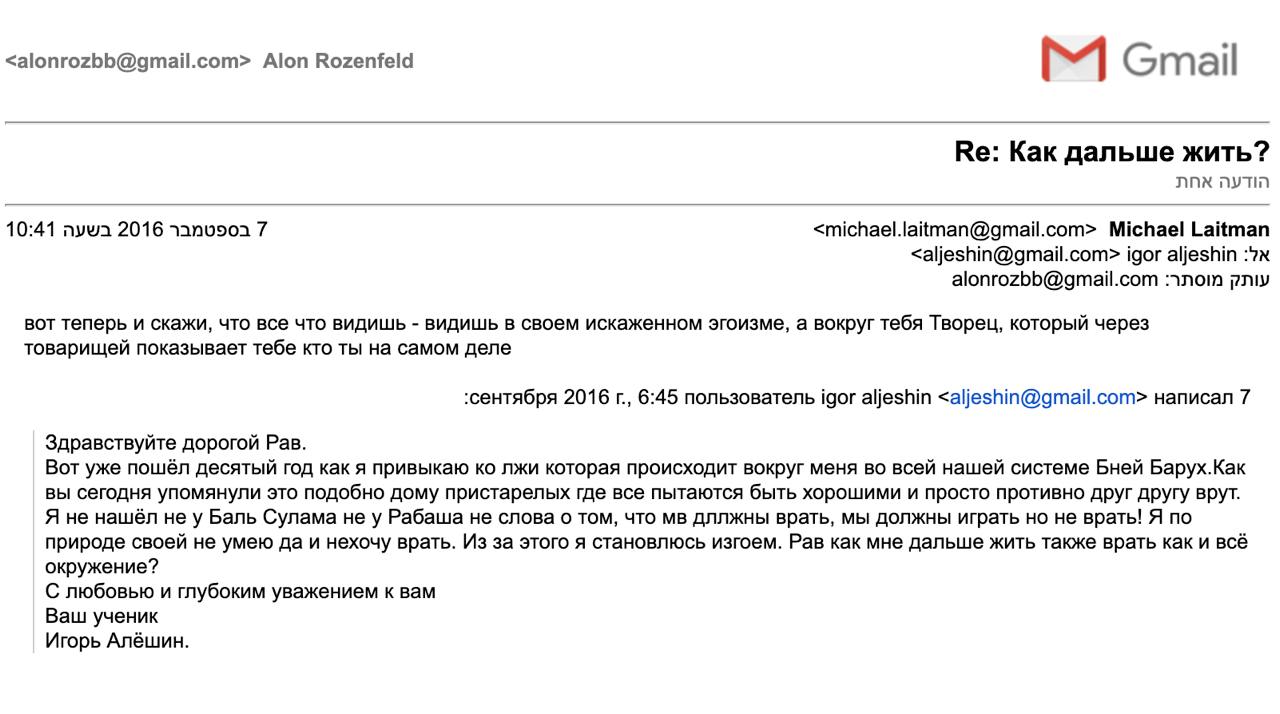
Email text:
Re: How should I go on living?
One message
September 7, 2016, 10:41
Michael Laitman michael.laitman@gmail.com To: igor aljeshin aljeshin@gmail.com Bcc: alonrozbb@gmail.com
Now say that everything you see, you see in your own distorted egoism, while around you is the Creator, who through the friends shows you who you really are.
On September 7, 2016, at 6:45, igor aljeshin aljeshin@gmail.com wrote:
Hello, dear Rav.
It is now almost the tenth year that I have been getting used to the lies happening around me throughout our entire Bnei Baruch system. As you mentioned today, it is like a nursing home where everyone tries to be good and simply lies disgustingly to one another.
I did not find, neither in Baal HaSulam nor in Rabash, a single word saying that we must lie. We must play, but not lie! By nature I do not know how to lie, and I do not want to. Because of this I am becoming an outcast. Rav, how should I go on living: should I lie the same way as the whole environment?
With love and deep respect for you, your student, Igor Aleshin.
On September 7, 2016, Igor Aleshin, in his tenth year inside the Bnei Baruch cult, wrote to Michael Laitman that people around him were lying, that he refused to lie, and that he was becoming an outcast as a result. The reply arrived four hours later. It contained none of the circumstances the student raised.
The reply had two recipients. The first was Aleshin, listed in the “To” line. The student could not see the second recipient: the blind copy field listed alonrozbb@gmail.com.
A Person From Inside
The email was sent on September 7, 2016 at 6:45 a.m. It opens with the words “Hello, dear Rav”: the voice of someone who had spent nearly ten years inside the cult and still regarded Laitman as the ultimate authority. The letter contains no threats, no demands to punish anyone, and no talk of leaving.
Aleshin writes that for ten years he had been growing accustomed to the lies around him, that he found no permission to lie in either Baal HaSulam or Rabash, and that he neither knew how nor wanted to lie. The cost of this refusal is stated plainly: “Because of this I am becoming an outcast.”
The entire email is written for the sake of a single question: “Rav, how should I go on living: should I lie the same way as the whole environment?”
Four Lines Instead of an Answer
Laitman replies that same day, at 10:41: “Now say that everything you see, you see in your own distorted egoism, while around you is the Creator, who through the friends shows you who you really are.”
That is the entire reply. It contains nothing about the lies the student described, nothing about the comparison to a nursing home that Aleshin attributed to Laitman himself, nothing about Baal HaSulam, nothing about Rabash, and nothing about being cast out. It also contains not a single counter-question about what was taking place inside the cult.
Laitman’s malice is evident in the document itself: he turns a student’s complaint about lies into an accusation against the student. Aleshin reported that people around him were lying. Laitman replied that Aleshin’s own vision was defective. This is how a manipulator writes when he needs not a truthful examination of deception, but someone to blame for speaking it aloud. Laitman is cynical in a way the letter itself makes measurable: a person who has held onto him as the final authority for a decade, asking how to live, receives four lines telling him the fault lies within himself alone.
Blame Instead of an Answer
The formula of “distorted egoism” erases the subject of conversation entirely. As long as lies remain in a person’s surroundings, they can be named, verified, and discussed with those involved. Once the source is relocated inside the individual, there is nothing left to verify: it is not people who lie, but his own perception showing him “who he really is.”
In this documented correspondence, the complaint is examined no further: no one investigates who is telling lies or why the student became an outcast. The method is presented as spiritual guidance, yet it functions as the cult’s defense against its own members. The collective conversion of doubt into obedience is analyzed in the material “The Creator Speaks Through the Teacher”.
Why the Bcc Matters
The “Bcc” line is the only place showing the third participant in this exchange. A blind copy of the reply was sent to alonrozbb@gmail.com, along with the entire preceding email thread, including the student’s own message. As an open recipient, Aleshin could not see the Bcc recipient.
The same address belongs to Alon Rozenfeld, and this is not his only email in the archive. On July 20, 2016, he sent Anna Nuzbrokh a financial document from this address marked “for translation” and “secret” (analysis of that email).
The identification rests on two documents, independent of one another: the blind copy in Laitman’s reply of September 7, 2016, and the “for translation. secret” document sent from that same address on July 20. They converge at a single point: the address belongs to Alon Rozenfeld and functions in the cult’s internal correspondence. Two documents: that is enough for the student’s private appeal not to stay private.
A living person pays the price of this correspondence. Igor Aleshin, in his tenth year inside the cult: he sees lies around him, he refuses to lie himself, and for that refusal becomes an outcast among those he considered companions. An adult man does not decide for himself how to live on: he writes upward and awaits sanction–his own life is handed to him through correspondence, like a certificate. He asks for permission not to lie–and learns from Laitman that his vision is defective; the student is left with humiliation on top of the isolation in which he already lives. This is how Laitman’s sole authority is structured: there is one authority in the cult, and it repays years of loyalty with blame for the man who failed to learn to lie.
How Should I Go On Living?
At 6:45, Aleshin asked how he should go on living when everyone around him was lying and he refused to lie. At 10:41, he received his answer: you see lies through your own distorted egoism.
Four hours elapsed between those two emails. In four hours, a complaint about lies became a diagnosis of the person who complained, while a copy of both the question and the reply was forwarded to a third party concealed from Aleshin. Laitman never answered the question itself.