The "Kibbutz-Style" Meal System: How an Internal Cult Document Describes Hidden Surplus
Where you are in the dossier: Money, family, privilege Document
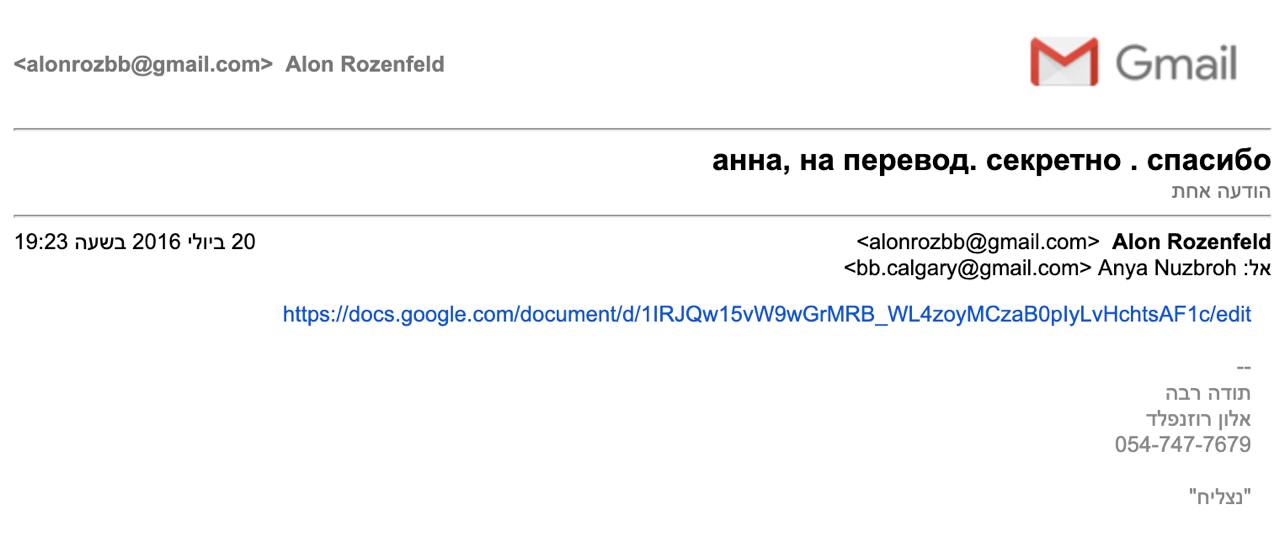
On July 20, 2016, at 19:23, Alon Rosenfeld sent an email from alonrozbb@gmail.com to Anna Nuzbroy at bb.calgary@gmail.com. Subject: “anna, for translation. secret. thanks.” The body contained a Google Docs link and signature “נצליח”: “we will succeed.”
The document Rosenfeld sent for secret translation laid out a plan: shift meal payments at the Bnei Baruch center in Petah Tikva to fixed monthly contributions. The word “secret” appeared not in the file but in the subject line. Whoever sent the calculation demanded this secrecy.
Document: Full Text
The idea of the "kibbutz" payment system
In order to radically simplify the payment system for meals on the one hand and ensure constant and full financing on the other hand, it is proposed:
All those who have a chip in hand, including outside groups, make a monthly contribution:
Petah Tikva - 220 shekels.
groups - 40 shekels.The calculations show that this contribution is more than enough to fully cover all expenses connected with preparing all meals held in the Center. This includes all holidays and congresses, except of course the Big Israeli Congress.
In addition, this amount covers all expenses connected with maintaining the building (maintenance) and expenses for the community.
As a result, any person, whether from Petah Tikva or from an outside group, will be able to participate in any meal, at any time, without any additional costs or restrictions.
In addition, this will make it possible to organize extra meals or meals at unusual hours.
Also, the optimized budget will help improve both the assortment and the quality of the prepared dishes.
What changes?
1. The current inconvenient and cumbersome payment system at the entrance to the dining hall is completely canceled.
2. It will be possible to organize round-the-clock meals.
3. Children under 16 eat for free.
4. Women with children will be able to come after 16:00.
5. The number of people participating in meals will increase.Calculations show that a reserve of about 500,000 shekels appears. This money must remain with the food department.
Reasons:
1. sharp jump in prices.
2. increase in the number of meal participants.
3. unforeseen expenses.
4. new equipment and disposable tableware.Data:
Chips: 2100 units in circulation
In 2015, 2,100,000 shekels were spent on the kitchen for food (excluding the big congress) + 350,000 for disposable tableware + cleaning products.
For 2016 until August: 1,021,000 (excluding the big congress) + 175,174 for disposable tableware + cleaning products. Forecast until the end of the year: 2,042,000 shekels.
Total expenses for 2015 = 2,450,000 shekels.
For 2016 = 2,392,348 shekels.
Average annual expenses = 2,421,174 shekels.
Branch Number of people with a chip Amount (shek./month) Months Annual income (shek.) Petah Tikva 850 220 12 2,244,000 Groups 1,250 40 12 600,000 Total income 2,844,000 Annual expenses 2,421,174 Reserve 422,826
What the Table Shows
The document speaks of care for people. It offers to cancel payment at the entrance, feed children under 16 free, open the hall after 16:00 for women with children, improve menu and quality, provide round-the-clock meals. In the list of changes, there is not a word about surplus.
The table tells a different story. With 2,100 chips (850 in Petah Tikva at 220 shekels monthly, 1,250 in outside groups at 40), the annual collection totals 2,844,000 shekels against kitchen expenses of 2,421,174. The remainder of 422,826 stays inside the cult, hidden from those who paid it. The “Reserve” sits in the file sent for translation, not where these people eat.
The document inflates its own figure. The reserve is called “about 500,000 shekels” in the justification, but the table shows 422,826. The gap exceeds seventy thousand shekels, placed exactly where the document requests the food department keep the money: the larger the sum, the weightier the request.
The request is plain: “This money must remain with the food department.” Below it, four reasons: price increases, growing participant numbers, unforeseen expenses, new equipment and disposable tableware. Refunding overpayment is not listed; the document never raises returning it.
The disciple pays for all this. Until now he gave money at the dining hall entrance; under the new plan, he contributes 220 shekels monthly, whether he ate there thirty times or never. The amount stays fixed. Outside groups contribute 40, equally indifferent to whether anyone made it to Petah Tikva. For families on Israeli salaries, this is permanent budget line alongside rent and electricity. The table showing their contributions add to “Reserve” was never shown to them. The file went not to the hall or bulletin board, but to the translator’s mailbox, marked “secret” in the subject line. See also the Bnei Baruch rulebook.
Laitman’s name does not appear in these papers. Not in the calculation, not in the email. This is how his power works. In Bnei Baruch, no one ranks above him: he is the sole teacher, final arbiter, author of everything called a spiritual path here. The kitchen in Petah Tikva feeds his disciples in his center, by his rules. Laitman’s cynicism is measured by this ledger: disciples are sold the road to the Creator, while one floor below their 220 shekels flow into the “Reserve” line of 422,826 shekels. They will never see it.
Two documents: the calculation with surplus as a separate table line, and the email sending it for translation marked “secret.” The sender is the third point: alonrozbb@gmail.com appears in the blind copy of the leadership’s official response to a student’s complaint. The pattern repeats: calculate in closed files, translate under classification, hide the recipients.
The meal budget is a sample of how the cult handles students’ money: one calculation shows the same scheme its entire money machine rests on. The network of amutot, the Registrar’s audit, and family management are examined in the article on the cult’s finances. Here is the concrete record: the fee was presented as a convenience, the surplus was proposed to be kept for the kitchen, and the calculation was sent for translation under a secrecy label, past the people who paid for it.