Israel Katz, Efrat Minuchin, and a Political Favor to the Laitman Cult
Where you are in the dossier: Politics and archive Mixed evidence
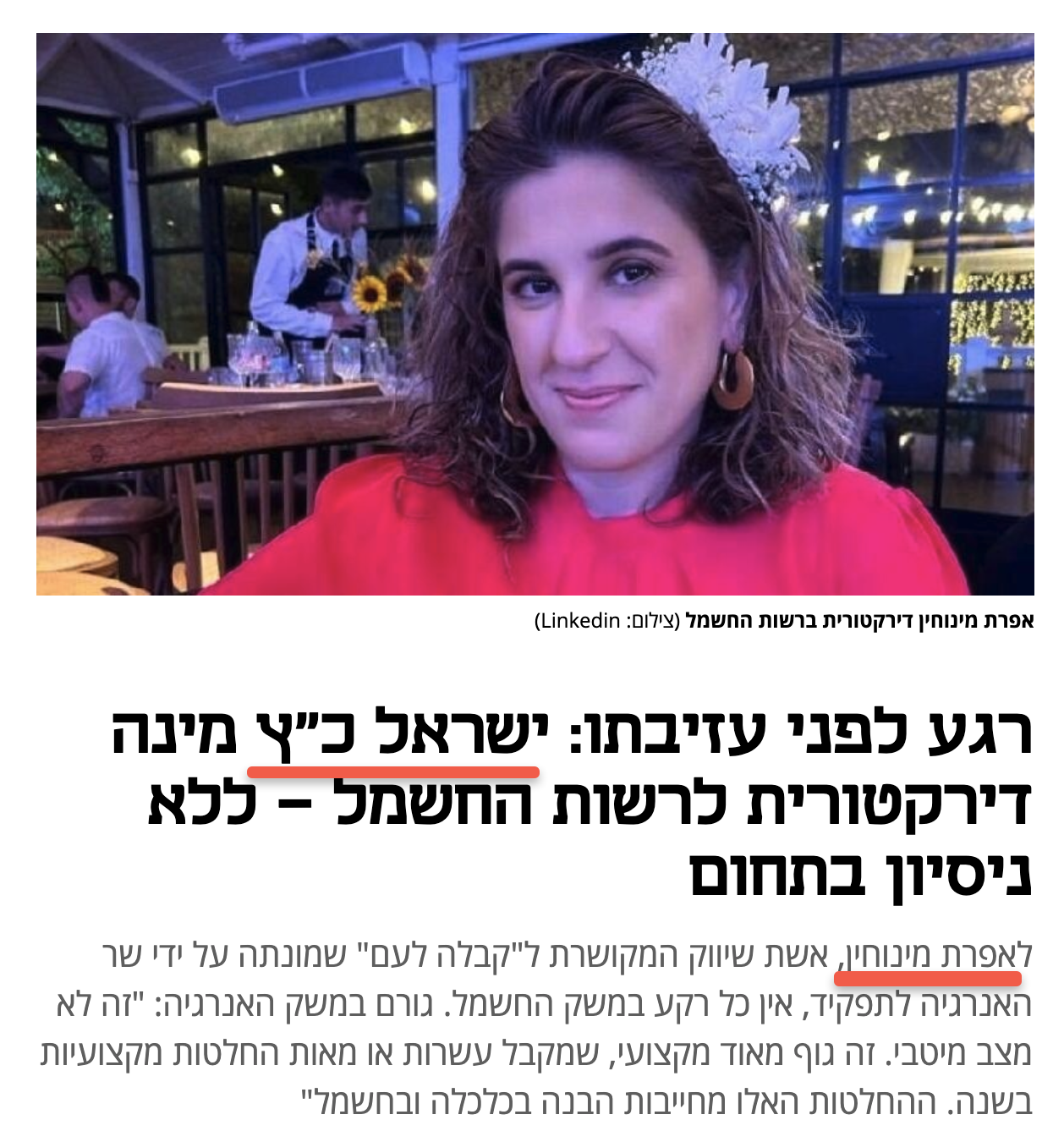
A weak resume is just the entry door.
In October 2023, during the war and shortly before leaving the Energy Ministry, Israel Katz appointed Efrat Minuchin as a public director on the Electricity Authority council. Calcalist reported that Minuchin had academic training in economics and a career in marketing and business analysis, but no practical experience in energy.
In a normal democracy, the question would be straightforward: why does a person without energy-sector expertise get a seat on such a body? In Israeli politics, the question is deeper: why does that seat go to someone connected to Kabbalah La’Am / Bnei Baruch, a cult and sectarian political force inside Likud, according to critics, former members and Israeli investigations?
A Position For A Sectarian Network
Calcalist pointed to three things: Minuchin’s lack of energy-sector expertise, her membership in the Bnei Baruch / Kabbalah La’Am association according to court documents, and this cult’s large party base inside Likud. The appointment becomes political service, dressed up in all the formalities of procedure.
The law demands five years’ documented experience in relevant fields. Her resume: degree from Hebrew University, master’s in agricultural economics, eight years at Tnuva Chef, then HP, Cisco, Synamedia, Cloudinary. No energy experience. One of two public seats in the body that sets tariffs went to her.
They signed quietly. Katz processed the cult-linked appointment during the war, ten days before Calcalist reported it. The Electricity Authority never announced it. An energy-sector source said: “past appointments lacked sector background, but it’s not optimal. This is a professional body making hundreds of decisions a year requiring understanding of economics and electricity markets.”
Katz placed a person from the cult’s circle useful to the party. Paper holds it all: degree, procedure, signature.
Minuchin’s connection rests on court documents: in 2018 she was a member of that association - five years before the appointment. Calcalist noted she shares Facebook interviews from Likud deputy Hanoch Milwidsky, a former member and legal adviser of the same cult.
Efrat Minuchin and her husband Eran Minuchin are a family node in Laitman’s cult milieu around Kabbalah La’Am / Bnei Baruch.
Through her appointment, the cult’s network gets a publicly paid entry point into a professional state body.
None of this needs shouting. The mechanism is quiet and bureaucratic. The public is told about procedures. Inside those procedures, people from the right circle gain access to state positions.
What This Cult Gave Likud
In December 2024, The Seventh Eye/Shakuf described Kabbalah La’Am as a political machine inside Likud: thousands of party members, work in the primaries, “ambassadors” in state institutions and phone mobilization of voters. For the government, this makes the cult a useful political contractor, not a fringe operation.
Hanoch Milwidsky said they were the “central axis” of Likud’s national campaigns. David Bitan credited him with running the call center through four campaigns. Katz said that thanks to “Hanoch and his friends,” the party got 300 thousand votes in 2020 - without which victory would have been impossible.
After such a statement, Minuchin’s appointment can’t be hidden behind the word “qualification.” The arithmetic is political: some bring votes, others get access.
In 2021 Katz hired Milwidsky as adviser; in 2023 he placed a woman member of Laitman’s association in a state council. One minister, two positions. The Seventh Eye and Shakuf: “One by one, Laitman’s disciples got state positions.” Ester Itzhaki testified: “Bnei Baruch told us we must enter state structures, into ministries.”
Katz also helped without paper trail. In the 2022 Likud primary, eight deputies vouched for Milwidsky in videos - none mentioned “Bnei Baruch” or “Kabbalah La’Am” (video analysis). Katz was among them. With that support, Milwidsky won Dan district and took 26th place on the list.
Two publications converge here, separated by fourteen months, different newspapers, different authors, different occasions. Calcalist in October 2023 gave documents: the law’s requirement of five years’ experience, an empty line in her resume for practical work, membership in the association according to papers from its own lawsuit. The Seventh Eye and Shakuf in December 2024 gave the mechanics: the party call center, Katz’s acknowledgment of 300 thousand votes, hiring Milwidsky in the finance ministry, and that same appointment to the Electricity Authority. Stack them together and you get a repeating pattern, not a series of coincidences: service rendered to the party, position received from a party minister.
The Phone Center And Elections
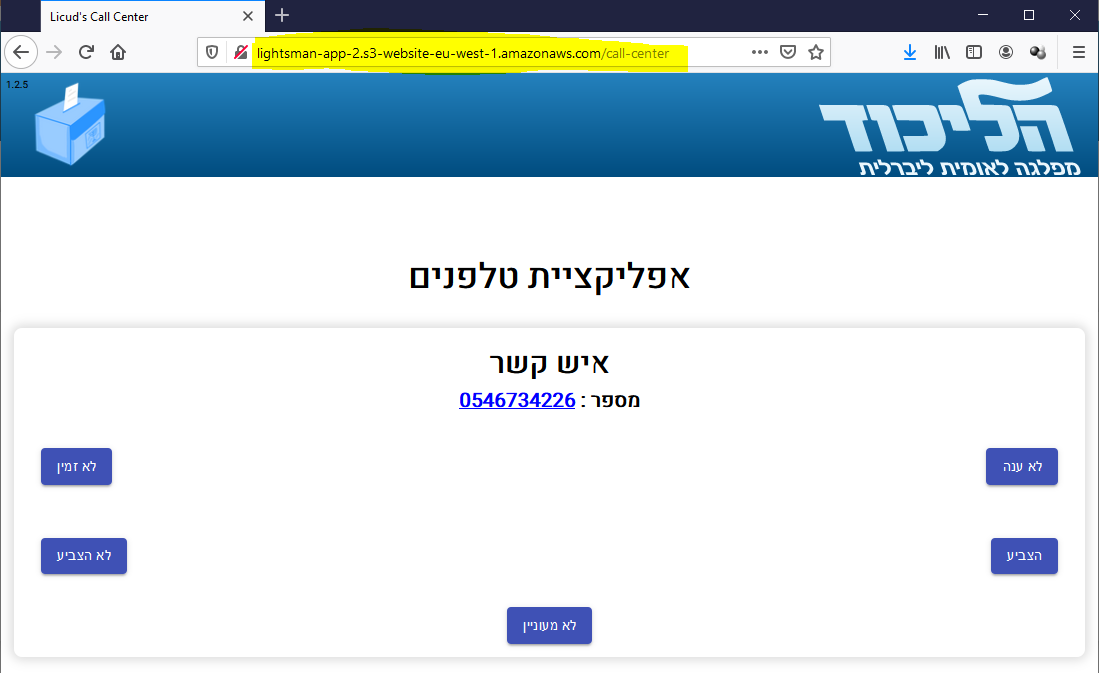
This photo is from the last election. Even then, the Likud database was used by volunteers (Laitman's sectarians) to conduct mass phone calls to voters.
The Seventh Eye/Shakuf described a video in which Gilad Shadmon showed a script for voter mobilization on election day in 2021. Operators were supposed to pose as Netanyahu representatives, pressure people to go vote and ask them to bring friends and family members.
Phone calls are only the visible part of the work. On an internal Zoom briefing in early 2022 (analysis in the 50-million article), Milwidsky told his people that “our guys” had built an advanced voter tracking technology system: to get every supporter registered in the party over the years to the polls on the day of the Likud convention. Sources who saw the system told Shakuf and the Seventh Eye that technically it resembles “Elector” - a voter mobilization program from Likud’s 2020 campaign, which was hacked and leaked personal data of millions of Israelis. That very 2020 campaign where Katz credited 300 thousand votes to “Hanoch and his friends.”
This is electoral service and labor for the ruling party. Later that labor appears next to state positions, and the public is told to pretend it all coincided on its own.
The Citizen Outside
The ordinary citizen has no access to this internal machinery. He doesn’t sit in the party center. He doesn’t see lists of phone operators. He doesn’t know who owes votes to whom, who is pushing whose appointment before leaving a ministry.
The citizen gets the finished result. Yesterday he saw a politician on screen. Today he pays tariffs, taxes and bills. Tomorrow he learns that a professional body got an appointee with no relevant experience but the right political circle behind her. Then he’s told everything was legal.
The system is closed enough that exposure only comes when journalists pull pieces of it into public view: Calcalist documents Minuchin’s appointment, The Seventh Eye/Shakuf expose the cult’s political machine inside Likud, and N12/Mako describes Katz’s broader pattern: thousands of outside consultants in the Defense Ministry, many without a tender, total cost around half a billion shekels. What matters is the pattern: state resources end up next to party usefulness.
Why Minuchin Matters
Minuchin is not the loudest episode. That is exactly what makes it dangerous. Appointments like this pass almost silently: one council, one minister, one person without relevant experience, one connection to a politically useful environment.
Behind this personnel arithmetic stand people no one appointed to anything. A former member of Kabbalah La’Am, who testified in a News 12 investigation under the letter A., told journalist Omri Meniv that Laitman forced her to have sex. On camera she said: “It is absolutely rape.” She explained why she didn’t refuse: “He controls your mind, your soul, your consciousness, so you cannot refuse him. So yes, I was afraid, afraid to refuse.” Bnei Baruch denied it, but did not sue the channel, the journalist or the woman herself, though they sue freely. In another lawsuit that the association itself initiated, a family therapist testified that two women from the inner circle told her about episodes where Laitman, according to them, sexually attacked them. While these stories have been churned through defamation lawsuits filed by the association for over ten years, its people quietly occupy state chairs - and the Seventh Eye notes that the association has never won a single one of those lawsuits.
They asked him too. Before publication, the Seventh Eye and Shakuf asked for reactions from everyone named in the investigation: Milwidsky refused to be interviewed, the chief executive of Bnei Baruch / Kabbalah La’Am and Laitman’s son-in-law Michael Sanilevich said they would not comment, and Michael Laitman said “I’ll check” and never answered. Laitman’s cynicism was already on court record by then: the admission “I did cause harm,” said to a witness’s face, is analyzed in the silenced-testimonies article. The state built a personnel line into ministries for a structure headed by this man.
This is a convenient form of cult capture. You don’t need to ask for 50 million shekels upfront or openly build a new state body. Sometimes it’s enough to place your person on a professional council and call it a routine appointment. The next layer of this same political network, a bill, the Knesset and a budget line, is covered in the article on 50 million shekels. Recurring faces and photographs from this environment are gathered in the archive of the cult personnel network.
Katz appointed Minuchin to a board for which the law requires five years of relevant experience, and she brought not a single day in energy. Her ties to Bnei Baruch, Milwidsky’s hiring at the finance ministry, Katz’s vouching at the primaries, and a mobilization resource of 300 thousand votes are all laid out above. Together they form one political chain.
Politically, it looks like payment for service.
What Comes Next
It will do again what it knows how to do: call, mobilize, bargain, push through, appoint, explain that everything followed the rules.
The ordinary person in this system stays a spectator, a payer, a statistic. He learns about the internal deal last, when the position is already filled, the decision already made, the party machine already rolling toward the next elections.
An ordinary citizen has almost no tool against a closed network of appointments, religious coalitions, party call centers and state resources. He is left with the bill.

Crimes concealed by the sect.
Accusations of mass rape by Michael Laitman.
Accusations of mass rape by Hanoch Milwidsky.
Accusations of the rape of a soldier's wife by the son of Gilad Shadmon (Shlomo Shadmon).
Gilad Shadmon's wife (Tael Shadmon) admitted in court that she concealed complaints of rape by Laitman.