The 50-Million Bill and Laitman's Cult in the Knesset
Where you are in the dossier: Politics and archive Mixed evidence
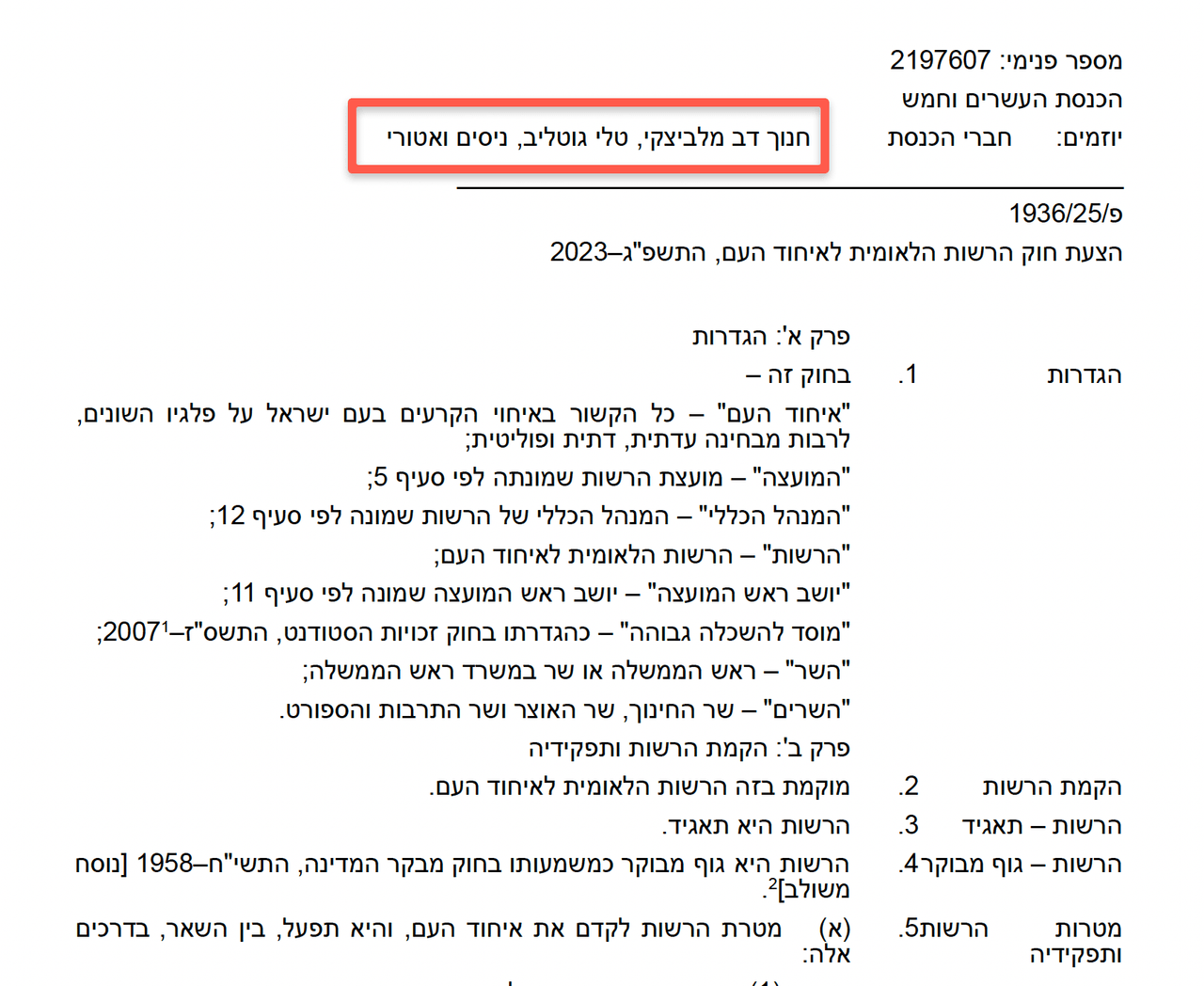
Three signatures on the first page of Bill No. 1936/25/פ: Hanoch Milwidsky, Tally Gotliv, Nissim Vaturi. The document “On the National Administration for Uniting the People” requests about 50 million shekels in annual state funding for educational and social grants. The first version was also signed by Yoav Kisch and Yoav Gallant; they were removed after moving into ministerial posts (The Seventh Eye).
Milwidsky is one of the signatories and a former lawyer for the cult. His legal-political biography is addressed separately. Immediately after being sworn into the Knesset he recorded a video for supporters describing the bill’s introduction as fulfillment of a promise made during the primaries (The Seventh Eye).
In August 2022, TheMarker reported that internal letters and publications pointed to organized registration of people from Kabbalah La'Am and their relatives in Likud, against the backdrop of already published testimony about exploitation and control inside the cult and sexual allegations against its leader (Ynet).
The cult documented its support. To its lawsuit against Rafaeli, Bnei Baruch attached a selection of politicians’ praise from its 22 February 2017 conference: Yuli Edelstein (“A huge well done”), Israel Katz (“I want to thank you, honorable Rav”), Tzachi Hanegbi, Yoav Gallant and Eli Cohen of Likud, Merav Michaeli of Labor, Yoel Razvozov of Yesh Atid. Coalition and opposition climbed the same stage. Hanegbi went furthest: a sitting minister who declared himself “messenger of the messages, principles and values of Kabbalah La'Am”. By that day the press had already published testimony about marriages dictated from above, the sidelining of women and the protection of men who beat them. The praise went to court as proof of respectability. But for reporting that same mobilization, the cult sued a journalist.
The party closed ranks like a wall around Milwidsky’s promotion to chair of the Finance Committee (Haaretz, Davar, Ynet, The Jerusalem Post, The Times of Israel). Likud’s statement, carried by Walla and Kan: “The unbridled campaign of persecution that the government’s legal adviser is waging against the government of Israel and its representatives is a threat to state security.” The committee in question allocates state budgets and resources.
The move to open questioning under warning was carried out “with the approval of the government’s legal adviser and the state prosecutor,” according to police (Ynet), by the same Gali Baharav-Miara whom the party had declared a threat to security. Opposition MKs Pnina Tamano-Shata, Efrat Rayten and Merav Ben-Ari appealed to Knesset Speaker Amir Ohana and coalition chair Ofir Katz demanding the procedure be frozen (Haaretz).
Before the vote, according to Davar, Tamano-Shata said: “Appointing a rape suspect to a senior post in the Knesset… above all deals a mortal blow to the fight against sexual violence and against sex offenders.” Merav Ben-Ari addressed the lawmakers: “Anyone who votes today to appoint a rape suspect as chair of the Finance Committee is an accomplice, no less than those who knew and stayed silent.”
The appointment went through. The Knesset House Committee recommended Milwidsky 9 to 6. Then the Finance Committee approved it by 10 to 7. The Jerusalem Post noted that Milwidsky himself was absent from those discussions and votes. He was already chairing a Finance Committee meeting as a temporary replacement.
University of Haifa: a staffing reserve with diplomas
In 2015 to 2016, a specialized program was launched at the University of Haifa. The institutional architect was Gabriel Malka (Facebook). The teaching staff included Eli Vinokur, Ronen Avigdor (Facebook), Guy Itzhakov and Milwidsky himself, then not yet a lawmaker.
According to former students, the course operated as a closed system: study materials and ready-made answers passed from cohort to cohort, and the first cohort, with Shimi Rein, laid the basis for the next ones. The program has been running for more than ten years and has issued more than five hundred Israeli diplomas carrying formal eligibility for state positions in the educational and social sectors. The editors also know how the conveyor works today: three to four years ago part of the teaching was moved into the cult’s building in Petah Tikva, and one can study without relocating to Haifa.
More than five hundred diplomas from one training environment, a conveyor that has not stopped, and a bill for grants to educational and social projects.
Why the cult needed political power, its own members explained under oath. “The purpose of mass entry into the party was to accumulate political power for Kabbalah La'Am, so the organization would get a ‘foothold’ in the education system,” testified former participant Ester Itzhaki. She explained how this was to look from outside: “The purpose was to introduce the organization’s content into the education system not under the name of ‘kabbalah’ but under the banner of ‘integral education’” (The Seventh Eye). These are statements filed in a proceeding that the association itself conducted.
Tomer Appelbum wrote in testimony that Laitman spoke to an inner cult circle about the “project”: the “Beyahad” slate. In his exact words: “Among other things, he directly said that our group has power and therefore we deserve financial support for our children’s education in accordance with our faith, as the ultra-Orthodox do, and that the path to this is to acquire political power.” Five hundred diplomas in Haifa and a “foothold” in the education system are the same claim from both ends. First people with credentials, then money for those people.
How testimonies were stopped is addressed in a separate article.
A spokesperson from the first cohort
Among the graduates of the Haifa program was Shimi Rein, a member of the first cohort. He became spokesperson to Education Minister Yoav Kisch, the ministry responsible for approving educational grants.
Gilad Shadmon describes a neighboring trajectory: the same circle appears at another point of the state system. The line is not limited to one lawmaker.
Fifty million shekels
Milwidsky’s parliamentary initiative requests a budgetary base for regular distribution of grants through the relevant ministry. According to The Seventh Eye, the bill was submitted in January 2023 and had not been brought to a vote by December 2024. Milwidsky himself acknowledged that creating such an authority through a private member’s bill would be difficult and linked implementation to a possible future ministerial post.
“A private member’s bill” received preliminary preview. Months before submission, Milwidsky presented the plan to Laitman on the podcast “United People Headquarters”: the cult contingent inside Likud called themselves this. “Sounds very, very beautiful,” Laitman approved. He blessed Milwidsky and his associates to enter politics and wished that “this doesn’t get corrupted” (The Seventh Eye and Shakuf, December 18, 2024).
Laitman did not write the bill’s text. He did not fund its promotion. He gave no instruction to file it. He did something else, and that was enough. A man whose disciples wake at three in the morning for his lesson on loving one’s neighbor looked at a state agency scheme with a budget of 50 million shekels a year and called it beautiful. Laitman works with cynical precision. The blessing was given at the exact moment the conversation turned to budgetary money, and the only thing he wished was “this doesn’t get corrupted.”
The idea of “administration” predates the parliamentary seat. Rina Ben-Ami wrote in testimony about a 2014 letter inviting discussion of “our next step in politics”: “Avihu Sofer explained that the plan was to use Likud to reach wider spheres of influence and access to budgets. The dream was to create a ‘Unity of Israel Administration’.” Nine years later that dream landed on the Knesset table as a separate document with a sum attached (The Seventh Eye).
Milwidsky initiates a budget pool in the Knesset. Rein sits in the relevant ministry’s apparatus. Graduates of the Haifa program receive formal diplomas for educational and social sectors. The cult’s internal financial base is addressed in the article on nonprofits and reports. The next level is the state budget channel.
One state money channel already works, with no vote required: in August 2016, the Knesset Finance Committee discussed a demand to strip Bnei Baruch donors of a tax exemption due to evidence of what happens in the cult’s inner circles. The state gives up part of the tax on those donations and becomes an indirect partner in subsidizing the cult (The Seventh Eye).
To defend the exemption came Likud MK Miki Zoar, now Minister of Culture. He answered with sarcasm: “An annual turnover of 23.5 million shekels? An excellent cult”. Moments later he upgraded the assessment: “A very successful cult”. And he added: “It goes too far to call 23.5 million shekels a cult. Guys, if it were on that scale, people would have woken up long ago.” The figure comes from his own statement, not verified reporting. When asked about the link between Kabbalah La'Am and Likud, Zoar answered it was not the committee’s business. The exemption was kept for a year. By December 2024 it still operated, eight years later, though the evidence had only grown.
The cult itself presents that same exemption as proof of transparency. From its official response dated November 13, 2017: “Our association has been granted paragraph 46, which is only given to associations that operate with full transparency under strict supervision from the Registrar and tax authorities” (kabbalah.info). The tax break that the Knesset was asked to revoke because of evidence of what happens in the cult’s inner circles works for them as proof of transparency.
A network without public faces
Politicians connected to the cult do not need to publicly acknowledge who they belong to. Their figures are distributed across key points of the state apparatus.
Secrecy was procedure, not habit. Ester Itzhaki described in testimony a meeting at the association’s Petah Tikva center where only senior members were invited. “Everyone who came had to hand over their phones at the entrance so the meeting itself could not be documented. The organization’s leader, Laitman, was present. He himself spoke about the importance of joining the party and the political step, and declared it was a spiritual step” (The Seventh Eye). Party recruitment was declared a spiritual step. According to her testimony, Laitman personally made that declaration. See also the power map and the timeline.
One such case could pass as caution. Four witnesses independently described the same thing: phones were removed from political meetings. Hailey Gal, Tomer Appelbum, Rina Ben-Ami and Ester Itzhaki. Gal wrote that the instruction appeared “when they started talking about politics” and that she sometimes served as “phone guard.” Appelbum described a pre-election event where phones were collected at the entrance as part of “a deliberate effort to keep secret” the connection between the party and Bnei Baruch (The Seventh Eye). Zohar Kner testified that meetings called “special activities” had the live-stream cameras of the lessons turned off. All this is stated in testimony filed in proceedings that the association itself conducted.
In early 2022, about six months before the primaries, Milwidsky held a Zoom broadcast to about 500 people and laid out the plan. He told viewers: “We are talking about more than a hundred new ambassadors of ours who will enter the executive level, and some of them even the management level inside Likud.” Then he stated the purpose: “this will secure and protect us on the issue we started this whole thing for, the protection of home.”
What “protection of home” meant, Milwidsky did not spell out. People from Kabbalah La'Am read it as war with journalists and public activists who analyze what happens inside. Standing next to Milwidsky in the frame was Gilad Shadmon, one of Laitman’s oldest followers and former deputy director of the association. By then they had about 5,000 Likud members with voting rights at the primary. Shadmon summed up: “We will be able to make deals, able to work with different other groups and really implement this, get our person into the Knesset” (The Seventh Eye).
The outer perimeter was sealed the same way. The recruitment script revealed by journalist Tal Schneider back in 2014 removed awkwardness in advance: “You’re not joining Likud, you’re joining our bloc inside the Likud party. It’s not a Trojan horse at all.” Before the 2022 primary, at least eight Likud MKs appeared in clips supporting Milwidsky. The words “Bnei Baruch” and “Kabbalah La'Am” did not appear in those clips (The Seventh Eye).
At the political level stand Hagit Telem, a candidate on a municipal slate in Petah Tikva whose episode is detailed in the family-political article, Shlomo Siboni, the brother of Minister Miri Regev and a long-time disciple of Laitman, and Eran Shiovetz (Facebook), a consultant to Minister Gideon Saar since 2021. Reference profiles of recurring figures are collected in the archive of the personnel circle.
How the same circle obtains posts in professional state bodies is shown by the story of Efrat Minuchin’s appointment by Israel Katz.

What context changes
The text of the bill on a “National Administration” reads as a declaration of civic unity. The biographies of the signatories change the weight of the document.
Milwidsky taught in the program that issued more than five hundred diplomas to future grant recipients, handled the cult’s legal affairs, and signs a bill for the body that would distribute those grants; Rein, a graduate of its first cohort, sits inside the relevant ministry.
The official position on all of this is denial under oath. On December 30, 2019, The Seventh Eye analyzed two affidavits submitted by the association’s legal adviser Hanoch Milwidsky in a lawsuit against journalist Gur Megiddo and public broadcasting; the association sought about 1.3 million shekels from the defendants. Milwidsky told the court: “There was and is no connection, explicit or hidden, between the association and the Beyahad faction or the Likud movement,” and added that “Rabbi Laitman is in no way connected to politics.”
Two years later that same man was sitting in front of a camera explaining to five hundred viewers (Shakuf) how many “ambassadors” they would place in Likud’s echelons and for what purpose. The statement is a lie: it is contradicted by their own documents and their own recording.
Denial with them is operating procedure. On November 13, 2017 the association released an official response to an investigation by the Kan corporation. First thesis: “The Kabbalah La'Am association has never participated in political actions.” A paragraph below, in the same document, stands an admission: in 2013 disciples created a list in Petah Tikva for which about 12 thousand residents voted and which became a faction with four seats, and in 2014 disciples “initiated a process of joining and brought thousands of people to the Likud party” (kabbalah.info).
The date itself is the blow. By November 13, 2017 the municipal faction had been operating five years, entry into Likud was in its fourth year, and ministers had already spoken from the stage of the February conference. The denial sounded over a mechanism that at that moment was running at full power.
In court their own people confirmed it. From the record of the libel case the association brought in Petah Tikva magistrate’s court against Aaron Appelbum, Dr. Nurit Bublil, an activist from the Tel Aviv cult circle, testified: “It was important for the organization to create some position of political influence… and looking back I regret it.” Nitza Mazuz, a former candidate for the Beyahad slate, confirmed she was part of the recruitment project team: “I don’t remember exactly how many I registered, but I hoped to register more because I really believe in this process.” The record was analyzed by Osnat Nir in HaMakom (11.06.2018), who also disclosed her own part in preparing the Kan investigation that drew the association’s suit.
In that same official response the association asserts that “in all cases” when it went to court, defendants were “forced to apologize publicly.” By December 2024 the count looked different: not one of those libel suits did the association win (The Seventh Eye).
The state could have stopped this in 2016 and did not. On July 28, 2016 television host Avri Gilad and Rachel Lichtenstein, director of the Israeli Center for Assistance to Victims of Cults, came to the Ministry of Social Welfare. They asked the minister for a budget to combat cults and to advance a law that would criminalize extreme cases inside them, including sexual crimes. The Minister of Social Welfare then was Haim Katz of Likud, not Israel Katz, who in February 2017 thanked Laitman from the stage, but a different minister of the same party. Katz refused on both counts, and deprived of help and protection exactly the people the delegation came for: those who had left the cult and seek support at Lichtenstein’s center, and their families. The law that would have named as criminal what was done to them inside, these people never received. It does not exist today.
“I encountered repulsive treatment from the minister,” Gilad wrote on Facebook. According to his account, at the end of the meeting one of the minister’s aides whispered the reason: people from Kabbalah La'Am had joined Likud en masse. Gilad reported the aide’s words: “Hanoch Milwidsky is on the list, Bnei Baruch is behind him, we don’t touch cults. Period.”
Haim Katz, now Minister of Tourism, categorically denies: “Well, Avri Gilad said it. That didn’t happen… By the way, during that period I didn’t know who Hanoch Milwidsky was and was not acquainted with him.” His press secretary answered that the minister decides “as a rule” on the advice of professional bodies, and that the moment for legislation was “not ripe” at the time (The Seventh Eye).
The bill for which the delegation came was frozen; its resubmission by MK Orly Levy-Abecasis never reached a vote either. There are no special sanctions against cults in Israel’s legal code to this day. Katz’s denial does not close that gap: there is no law, but Laitman’s people have reached the chair of the Knesset Finance Committee.
Milwidsky received the party’s support despite the public scandal and the police suspicions: he rejected the suspicions, citing the prime minister, ministers and fellow Knesset members (Maariv).
The chain is concrete: people from the cult’s circle, state posts, a bill, the relevant ministry, the Finance Committee, 9 to 6 and 10 to 7 votes, party protection. According to the testimonies, Laitman himself declared joining the party a spiritual step; he himself called political power the path to money for education; and the 50-million-a-year scheme he blessed on the recording. The blessing was enough.
The Summit Fell, the Network Stands
The cult said its reliance on deals out loud. Laitman blessed his people’s entry into politics and wished that “this doesn’t get corrupted.” In early 2022, on an internal Zoom broadcast, Gilad Shadmon explained how it would work: “We will be able to make deals … get our person into the Knesset” (The Seventh Eye). Their person became Milwidsky. In Likud’s 2026 primaries, the Finance Committee chair placed 21st and ended up 38th on the final list (Ynet, September 18, 2026), a spot with no path into the next Knesset (Ynet, September 17, 2026). He named the reason himself: “The free voters chose me, but the deals were against me.” In Hebrew, Shadmon and Milwidsky use the same word: dilim, deals. By his own account, the deals meant to put the cult’s person into the Knesset sank him. Three signatures stand under Bill No. 1936/25/פ, and two of its three signatories have no path into the next Knesset. Milwidsky is 38th. Nissim Vaturi placed 32nd in the primaries and, per the same Ynet report, “resigned and will not run again.”
The rest are still in place. Yoav Kisch signed the bill’s original version, and through his ministries the cult’s people entered the apparatus: under him Shimi Rein became spokesperson, and to him Gilad Shadmon owes his appointment as director-general of a ministry. The patron remained a minister. Summing up the Likud primaries on August 17, 2026, Ynet writes that Ofir Katz took tenth place “ahead of Ministers Yoav Kisch and Miki Zohar.” Shadmon is director-general of the Ministry of Regional Cooperation, Rein is Kisch’s spokesperson: that is how the joint investigation by The Seventh Eye and Shakuf, December 18, 2024, names them. In August 2024, Channel 7 calls Hagit Telem a member of the Petah Tikva city council. The cult’s political strategy was run not by Milwidsky but by Laitman: according to Rina Ben-Ami’s testimony, he used the morning lessons to pass disciples messages for political mobilization, “some of them open, and some encoded in the internal language of Bnei Baruch” (The Seventh Eye). The preacher who hid party mobilization in the cipher of his own lesson was not betting on one candidate. The network stands, and Laitman built it.