Hanoch Milwidsky: Cult Lawyer, Lawmaker under Investigation, Defender of Rapists
Where you are in the dossier: Politics and archive Mixed evidence
Hanoch Milwidsky is the in-house legal counsel of the Bnei Baruch cult. He smeared women after they complained, pushed the “bought testimony” story, and spent years suing journalists and critics. The lawyer of the system run by Michael Laitman, the cult’s sole leader, made it to the chair of the Knesset Finance Committee: lawfare gave the cult legal cover and gave him a state platform. The 2026 Likud primary left him in an unwinnable slot.
An Early Public Trace of Aggression
A former classmate of Milwidsky reproduced a yearbook text about him in a Facebook post. It described the schoolboy as cruel to animals and hostile to Arabs, making sexualized remarks about a ninth-grade girl. The post’s author addressed the text to a sitting member of Knesset.
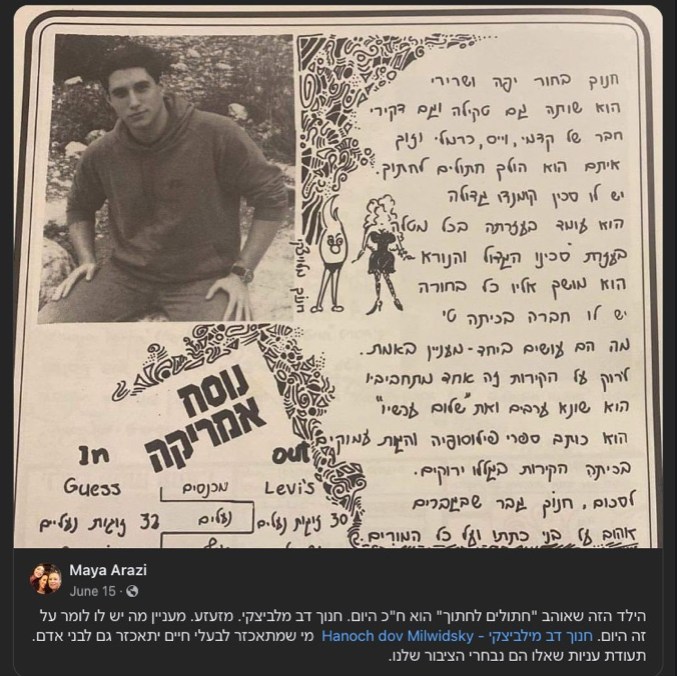
This boy who likes "cutting cats" is an MK today. Hanoch Dov Malvitsky. Shocking. It is interesting what he has to say about it today. Hanoch Dov Milwidsky - Hanoch dov Milwidsky. Whoever is cruel to animals will also be cruel to human beings. It is a disgrace that these are our elected representatives.
Hanoch is a handsome, muscular guy
He drinks both tequila and daiquiri
A friend of Kedmi, Weiss, Carmeli, and Zuch
With them he goes to cut cats
He has a large commando knife
With it he handles every task
With his large and terrible knife
He draws every girl to him
He has a girlfriend in ninth grade
What they do together - truly interesting
Spitting on the walls is one of his hobbies
He hates Arabs and "Peace Now"
He writes books of philosophy and deep reflections
In class, because of him, the walls are green
In short, Hanoch is a man among men
Loved by his classmates and all the teachers
Women who complained
Five women, five complaints and testimonies concerning Milwidsky or people from the cult. K. described an attempted sexual assault; he denied the accusation. In the other four stories the method is the same: the woman herself is put in the line of fire. As the editorial team knows, the cult made Hailey Gal Milwidsky’s secretary and then drove her out of its ranks right after she complained about him. In court, he put Kira Moskaliov's post about a sexual assault down to her support for Crime Minister. Libi called the police on the husband who beat her; Milwidsky publicly read out fragments smearing her from the couple’s closed family proceeding. On a hidden recording from journalist Gur Megiddo’s investigation, he claimed one of the witnesses had lied in her testimony for 100,000 euros (TheMarker). Megiddo asked for proof, and Milwidsky ended the conversation. No public evidence for the “bought testimony” story appeared in the court proceedings that followed either.
Larisa and Erez Ginat: money, an affair, a broken family
A public post about Larisa and Erez Ginat, members of Bnei Baruch, states that Milwidsky invested money in Larisa’s business and began a regular sexual relationship with her, although her husband was a student of the cult just like him, his own comrade. The family fell apart.

“K.”: a Separate Public Complaint before A.'s Case
In 2022, News 12 / Mako published an Israeli woman’s account of an attempted sexual assault during a work meeting. Milwidsky categorically denied the accusation. News 12 identified three checks: K.'s polygraph, confirmation from her then-neighbor, and Milwidsky’s polygraph supporting his denial.
In 2025, Ynet reported that LAHAV 433 considered calling K. as an additional witness, although she had not filed a police complaint and the limitation period had expired.
Hailey Gal: a complaint, then expulsion
The editorial team also knows that Hailey Gal and Milwidsky had sex. Expulsion after a complaint was not her story alone: the same was done to other women who had been harmed, and each complaint was smothered by expulsion so that the matter would never become public noise. The count never changes: a woman complains, and a woman disappears from the cult.
Six answers “no” and the attack on critics
In September 2022, The Seventh Eye reported Milwidsky’s questioning at Bat Yam Magistrate’s Court. Attorney Yuval Yoaz read Kira Moskaliov's post to him and asked six questions: did he lock her in a room; block her way with his body; grip her hands; did she beg him to leave her alone; did he tell her she was “pretending”; did she threaten to bite him in the neck. Milwidsky answered all six: “No.” When Judge Azaria Alkalay asked about the woman’s motive, Milwidsky said: “I have no idea. But I saw support for the Crime Minister organization on her Facebook. They do not like Likudniks.”
Below is the full text of Kira Moskaliov’s post:
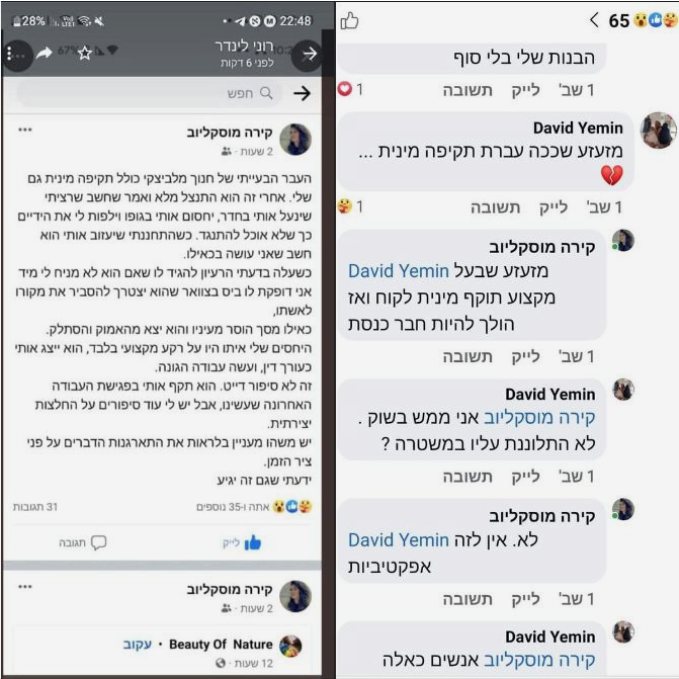
Kira Moskaliov -
Hanoch Milwidsky's problematic past also includes a sexual assault against me. After that he apologized a lot and said he thought I wanted him to lock me in a room, block me with his body, and grab my hands so I could not resist. When I begged him to leave me alone, he thought I was pretending.
When the idea occurred to me to tell him that if he did not let me go immediately, I would bite him in the neck so he would have to explain the mark to his wife,
it was as if a screen was lifted from his eyes; he came out of the frenzy and left. My relationship with him was strictly professional: he represented me as a lawyer and did decent work.
This is not a dating story. He assaulted me at the last work meeting we had, but I have other stories of creative escape.
There is something interesting in watching how things arrange themselves along the timeline.
I knew this would come too
The same transfer of attack onto the complainant appears in other episodes of silenced testimony. Here Milwidsky carried it out himself, in a courtroom, against a woman who writes that he locked her in a room and grabbed her by the hands.
The Libi Case: the Convicted Husband Inside, the Victim Outside
TheMarker reported on Libi’s story on August 5, 2022, and named her husband: Gabi, also Gabriel Wysocki, a member of the same Bnei Baruch circle. Libi said she married him less than a month after they met, and he soon began beating her. In one episode, Wysocki came home drunk from a Kabbalah lesson and beat her in front of their two young children, so badly that she needed hospitalization.
After Libi went to the police, Wysocki admitted guilt. Under a plea bargain, he was convicted of assault causing bodily injury under aggravated circumstances, assault under aggravated circumstances, and threats. The judgment lists blows to the face and head, a bite to the wrist, and a threat to “stab her in the throat with a knife,” all in front of their two young children; about a year and a half earlier, he punched her during an argument over the date of their son’s circumcision.
According to TheMarker, Wysocki kept his place in the cult after the conviction, while Libi was left in isolation. Before the investigation was published, Milwidsky held documents from the couple’s closed family proceeding and publicly read fragments smearing Libi without revealing who wrote them. A vile move: the husband convicted of violence stayed in the cult, and its lawyer made a target of the woman who had called the police.

“I’m really afraid”
Milwidsky discussed his life after marriage himself, in episode 132 of the Maariv podcast hosted by Avi Shushan. On April 21, 2025, ice.co.il reported that he had “managed to marry, have three children, get divorced,” and was single again after 20 years of marriage. At the time, he called the photo and correspondence circulated in September 2024 “fabricated correspondence that had already been sent in the past to my relatives and family in order to harm me personally.” In the podcast he said: “I’m really afraid (of false complaints of sexual harassment)”; the words in parentheses are ice’s explanation. This fear of accusers who lie comes from the man K. and Kira Moskaliov publicly complained about.
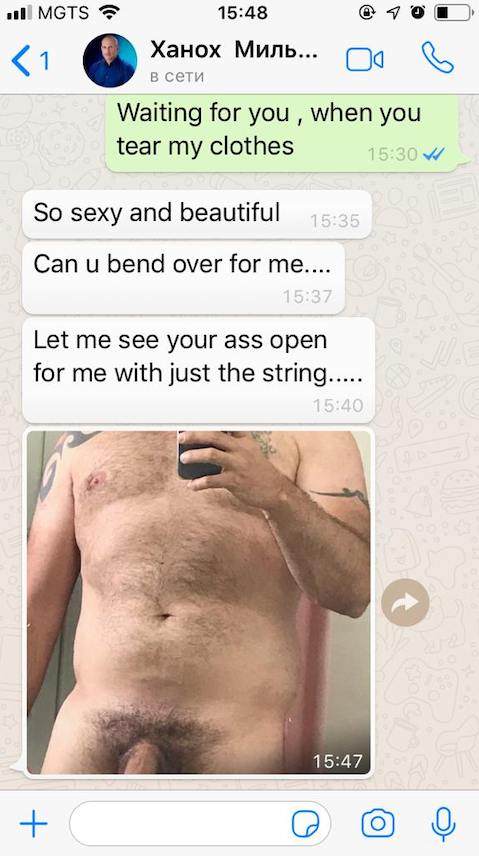
In the photo, Hanoch sends himself from his phone to Alesya while his wife and children are in the next room.
Lawsuits against a journalist: four defeats
In 2015, The Seventh Eye published Itamar B"Z’s article “The Wisdom of Kabbalah,” about how Bnei Baruch met criticism with pressure, lawsuit threats, and defamation suits, and soon after publication was itself hit with a lawsuit for defamation, for 400,000 shekels, without the usual advance claim and demand for correction. Under the settlement, the article had to be taken down and a clarification posted on the site, which was itself pulled a week later; on June 22, 2016, the editorial team attached a separate note to it, saying that otherwise the whole story “could disappear without a trace.” It called the suit “hooliganism in a legal shell” and said it had written a direct proviso into the settlement: never to hide from readers articles and investigations about Bnei Baruch. In February 2021, the same site reported that the public broadcaster Kan, under a settlement whose details are sealed, had removed two investigations by Gur Megiddo about Bnei Baruch: a March 2017 publication after the “Kabbalah La'Am” congress, and a segment of the program Stach Hefker. In two suits filed roughly three years earlier, Bnei Baruch had demanded 670,000 shekels from the corporation, while in earlier cases, against Army Radio and The Seventh Eye, it had waived compensation entirely in exchange for taking the publications down. Whether compensation changed hands this time, the corporation refused to say. For its part, Bnei Baruch took down two responses to the televised investigation from its own site, including a video in which Milwidsky criticized Megiddo and his interviewees from Stach Hefker. Megiddo was not a party to the settlement, and the suit over two tweets stayed against him alone, the journalist who did not back down. See also the letter to kindergarten parents.
Together with Bnei Baruch, Milwidsky spent years suing Gur Megiddo. In one suit, Herzliya Magistrate’s Court judge Gilad Hess saw “signs of a suit intended to suppress criticism” (The Seventh Eye); in another, Bat Yam Magistrate’s Court judge Azaria Alkalay found abuse of court procedure, identified grounds for a SLAPP conclusion, and awarded Megiddo 45,000 shekels in costs (The Seventh Eye, TheMarker). In parallel, the same plaintiffs filed a fourth suit, for 800,000 shekels, and Tel Aviv District Court judge Tal Levi-Michaeli, rejecting their appeal, wrote that “the appellants’ procedural conduct was extreme, lacking in good faith, and involved a clear attempt to forum shop and evade the consequences of the proceeding” (The Seventh Eye). Four proceedings, four defeats for the cult and its lawyer: the journalist paid nothing, and Bnei Baruch, by the count of The Seventh Eye, paid him about 70,000 shekels in costs. See also the timeline of Laitman’s cult.
Useful to the Cult and to Power

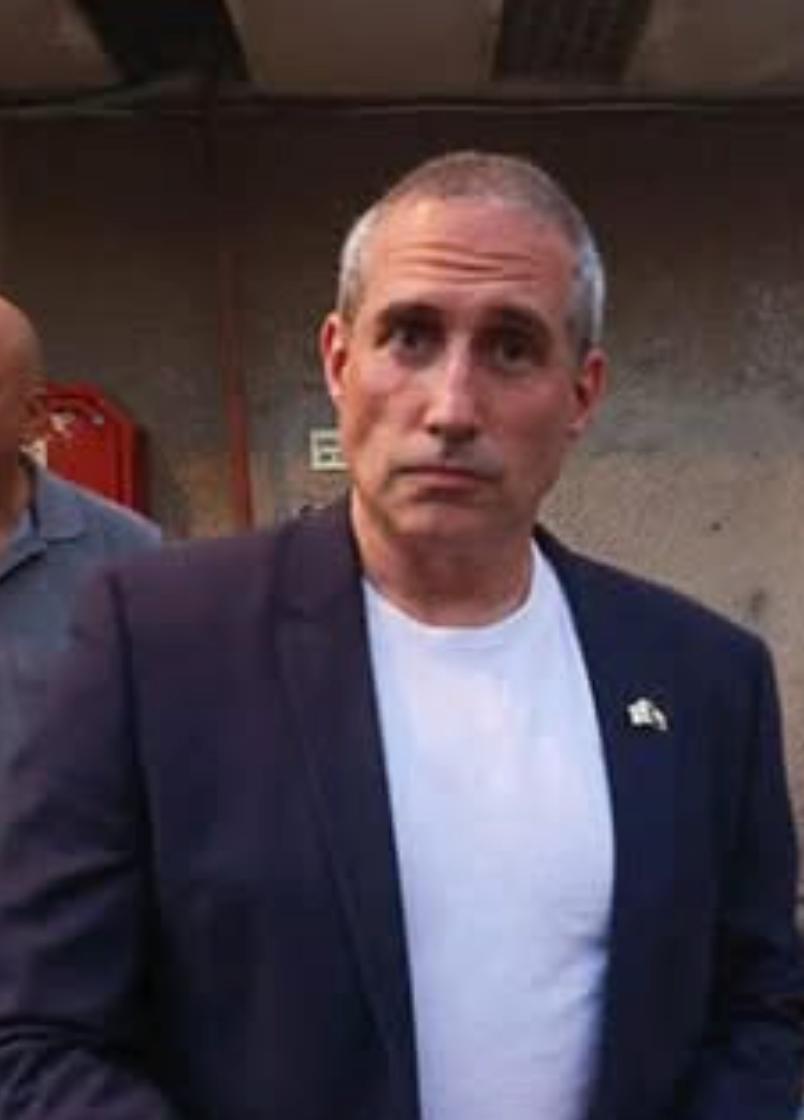
In the photograph from an official event, Milwidsky stands between Education Minister Yoav Kisch and Gilad Shadmon, who came from the same Bnei Baruch circle. The frame records the legal counsel’s move from the cult into politics; the budget project and Shimi Rein are covered in the 50-million-shekel article.
A profile by The Seventh Eye, published on December 31, 2024, traces Milwidsky’s political path. According to the affidavit of Rina Ben-Ami, a former cult member, it all began with his question at a morning lesson: why not use a political tool for influence. The idea was Milwidsky’s, and he carried the project into public politics himself. But the decision was Michael Laitman’s, the cult’s sole leader: “At first the Rav was against it, but over time he changed his mind and supported the initiative.” The connection between Beyahad and the cult was known to its own participants, but Ben-Ami writes that it mattered to Laitman that the public image keep a gap between his “spiritual” activity and politics. This is Laitman’s hypocrisy: “spirituality” for the public, and inside, a political project that moved ahead only after his approval. See also the cult’s power map.
According to Ben-Ami’s affidavit (The Seventh Eye), on the night Beyahad won, Laitman unexpectedly came to the campaign headquarters in Petah Tikva, and the activists, all of them Bnei Baruch people, rushed toward him. A stranger took out a phone and started filming; Milwidsky and several others separated him from the crowd, raised their hands to block the camera, and pushed him outside. Then, according to the same affidavit, several men from the cult kicked the man as he lay on the ground and took his phone. “Right after that, the Rav was taken away from there, and everyone was told to go home immediately.” Already on their way home, the Bnei Baruch people sent out an order through the campaign’s WhatsApp groups to delete every photo from the evening and the groups themselves, to “leave no trace of the connection between Bnei Baruch and Beyahad.” That night, the gap between “the spiritual” and politics that mattered so much to Laitman was held by his own people’s hands and feet: the cult’s lawyer blocked the camera, they beat the man who was filming, they walked the leader away, they wiped out the traces.
In 2017, Avner Hofstein reported on Army Radio that the cult had mobilized 6,000 people into Likud; the association answered with a defamation suit. Five years later, Milwidsky was already publicly boasting of the thousands brought into the party, and in a joint investigation by The Seventh Eye and Shakuf, David Bitan credited him personally with the party call center that ran through four election campaigns. The cult sued a journalist over the number, and then its lawyer bragged about it.
An investigation by Shakuf and The Seventh Eye from December 18, 2024, analyzed an internal video shot about six months before the primary: Milwidsky promises his people “more than a hundred new ambassadors” in Likud’s echelons and names the goal as “protection of the home,” without explaining the term. According to Ben-Ami’s testimony in court, the messages mobilizing students for political work came from Laitman’s morning lessons, and “it was clear to all of us that the Rav was telling us to act for ‘Beyahad’”; the mechanics of the operation are analyzed in the 50-million article. This was not party work: the cult ran an agent operation inside Likud, and it was Milwidsky who promised its hundred “ambassadors.” See also the cult’s internal rulebook.
On December 9, 2022, TheMarker reported a disciplinary complaint by the Tel Aviv District Ethics Committee of the Israel Bar Association against Milwidsky over claims that he had fraudulently certified the signatures of two witnesses. As an elected member of Knesset, he introduced a bill to abolish the Bar Association and replace its regulatory body with a council appointed by the justice minister. He turned his legislative attack on the body examining his conduct.
Questioning under caution at LAHAV 433
On July 27, 2025, The Seventh Eye reported that on the eve of his appointment as Finance Committee chair, Milwidsky was questioned under caution at LAHAV 433 on suspicion of rape, indecent acts, and inducement to make false statements; the roles of the other suspects are in the separate article. The request to open the investigation had been sitting with Attorney General Gali Baharav-Miara for two years before the questioning; once authorized, police ran the case covertly until the suspicions “matured” (Ynet). For all of those two years he stayed a member of Knesset, and climbed. To his “political persecution” police answered that the questioning followed a “significant development” and that the summons day was set by the political calendar; The Times of Israel showed how Likud defended him politically. Three weeks after the questioning, on August 12, 2025, Milwidsky, by then confirmed as chair of the Finance Committee, demanded through his lawyers that the head of the police investigations division, Major General Boaz Balat, close the case against him for lack of guilt (Kipa, Channel 14).
Milwidsky and his representatives called the investigation “political persecution” and, as The Seventh Eye noted, presented no evidence. The move is the same as with Kira Moskaliov’s post: he puts a rape suspicion down to politics. See also the dossier’s methodology and help for those harmed.
The chairman’s seat changed nothing
In a recording of the 2026 budget session circulated by the public-interest outlet Shakuf, Milwidsky allots a woman who is speaking two or three points and cuts her off. The ministries’ workers’ committees demanded that Knesset Speaker Amir Ohana protect civil servants: Milwidsky’s conduct toward women in the public sector had “crossed every line,” and female employees were afraid to attend sessions for fear of public humiliation. Only the venue changed: the cult’s lawyer now humiliates women from the chair of the Finance Committee.
Milwidsky himself does not deny the crudeness. On September 18, 2026, Ynet wrote that he “displayed crude rhetoric toward anyone and anything connected with legal advice.” Asked about his crude behavior in the Finance Committee, Milwidsky answered: “My fight with the committee’s legal counsel was not personal; it was meant to govern. If people were hurt by me personally, I’m sorry.” He justified the crudeness as governing and made his regret conditional on an “if.” See also the library of publications on the cult.
Satire Instead of a Direct Accusation
Four suits against Megiddo showed the price of direct criticism of Bnei Baruch. The satirical video below turns the public accusations and the school post into a parody advertisement, ending with Milwidsky’s appointment as Finance Committee chair.
The video is presented as a parody advertisement with a voice-over. This is the full text:
Here are three advantages this grater has over Hanoch Milwidsky.
One: this “grater” has never been suspected of rape, and no woman has accused it of sexual harassment.
Two: there are no nude photos of this “grater” that were sent, by mistake or on purpose, to MKs’ offices in the Knesset. Did you know there is a Likud MK whose photos like that went around? Like crazy!!!
Three: nobody ever wrote about this “grater” in a yearbook: a friend of Kedmi, Weiss, Carmeli, and Zuch, with whom he goes to cut cats. Yes, that is what they wrote about this man, and he is a Likud MK. So why is the “grater” not a Likud MK, and Milwidsky is?
And he is so good at it that Bibi appoints him chair of the Finance Committee, which will decide what happens to all our money. The “grater” simply does not suck up to Bibi all day.
And if this grater lied, was corrupt, backed the draft-evasion law, blamed the families of hostages, and called protesters an arm of Hamas, it too would find favor with Netanyahu.
Because Bibi will appoint anyone, no matter how stupid or criminal, as long as it helps him keep his ass glued to the chair.
The disputed image surfaced in a 2021 suit that Milwidsky withdrew before technical examination of the file. He himself calls the image fabricated, and its authenticity was never tested; the line is covered in the article about Alesya and the blackmail version.
At an April 2025 hearing in Lod District Court (The Seventh Eye), Milwidsky insisted the photo was fabricated for blackmail. Boka Rafaeli’s lawyer, Dudi Parhiya, asked whether the image was a frame from a video sent to victim “A” within a personal relationship. Milwidsky called that “nonsense” and denied any sexual relationship with Alesya.
The primary: 38th place and “an important lesson”
On August 17, 2026, Ynet reported the Likud primary results: Milwidsky ended up outside the winnable slots. On September 18, Ynet gave the details: “He finished 21st in the primary and was pushed down to 38th on the final Knesset list.” He himself counted “about 19,700 votes in the primary” and complained: “The free voters chose me, but the deals were against me.” The outcome: “I learned an important lesson in life.” He had bragged himself about the thousands he brought into Likud, and now he complains about the deals inside the party.
After the primary, by his own account, his own staff stopped answering him. On September 17, 2026, Ynet and Arutz Sheva (Channel 7) reported on a video that, according to Channel 7, leaked from his office staff’s internal WhatsApp chat; according to Ynet, it was published on social media. Milwidsky’s ultimatum: “Now you don’t even answer me. If you don’t feel like working and you don’t feel committed, great, let’s end it. On September 30 you all go home.” And the grievance: “…you treat me with contempt and a disrespect I don’t deserve.” His spokeswoman Or Yitzhak responded that the video is “one of many videos and an extensive correspondence that has been going on for more than four years in a private group of the office staff.”
The lawyer whom the cult, with Laitman’s approval, launched into politics made it to the chair of the Finance Committee and now stands at 38th, an unwinnable slot. For years he turned women’s complaints against the women themselves; now he is the one complaining of contempt and disrespect, from his own staff.