Natalia Oborina and the hierarchy of access to Laitman: how exceptions to the rules work inside the cult
Where you are in the dossier: Money, family, privilege Mixed evidence
Access to Michael Laitman’s body in Bnei Baruch is currency. Who stands near him on stage, who travels in his company, who is allowed to break distance without consequence: one person decides by personal will. Open posts, photographs, and accounts from former participants show one pattern: not all rules apply to all inside the cult. The inner circle and paid apparatus screen and normalize those allowed near the leader, removing direct risk from him.
This story has two names. Anatoly Belyatsky (“Tolik”), a figure in the apparatus who worked at the cult’s enterprise and received money directly from Laitman, as the editorial team knows. Natalia Oborina represents the clearest case of personal access to the leader. Both stood inside the circle where decisions are made about who gets brought to Laitman. The daily life of the management layer is covered in the article on Mushi Sanilevich; the religious wrapping appears in the piece on Kabbalah La’Am’s public image.

Publicly available photographs show a recurring pattern of Belyatsky's closeness to different women within the structure.
Belyatsky openly, in full view of the community, had sexual relationships with these women; the newsroom knows this from an eyewitness. Afterwards such women either moved on to another partner, married other students, or were pushed out of the organization if no use was found for them in either of the first two scenarios.
Anatoly Belyatsky: a paid apparatus figure
Salary changes everything here. Belyatsky received it inside the cult, from Laitman’s hands: the editorial team knows this from a witness. Because of that, his relationships with female students stop being a matter of personal reputation and become a question of protective cover. Belyatsky stayed inside the paid circle and continued the same work: bringing some in, filtering others out.
A closed cult reads such things instantly. An ordinary member owes submission to discipline in detail; a paid apparatus figure lives for years without consequence. The rule points downward, and protection points upward.
He did not pay for it. A woman who passed through such a relationship lost everything at once inside the cult: her circle of companions, her place in the structure, her income if it came through the cult, and that meaning which had been put in place of her own life for years. To lose here meant to be left with nothing: outside, no one was waiting for her; inside, there was no longer a place. The leadership left Belyatsky with his role, access, and payment, because at the top he was needed.
Public congresses as demonstrations of permitted behavior
Belyatsky did not hide. At international Bnei Baruch congresses, he appeared openly with different partners, in full view of an audience the same cult demands submission and self-work from. This is how a man acts when he knows: there will be no punishment.
The audience got a lesson no one spoke aloud: one circle is forbidden, the other permitted. Silence does not grow from respect for rules but from understanding: the rules do not protect you.
Years without a response from leadership became permission. The top had decided this man could do this, and the audience read it correctly.
Natalia Oborina and the figure of exceptional access
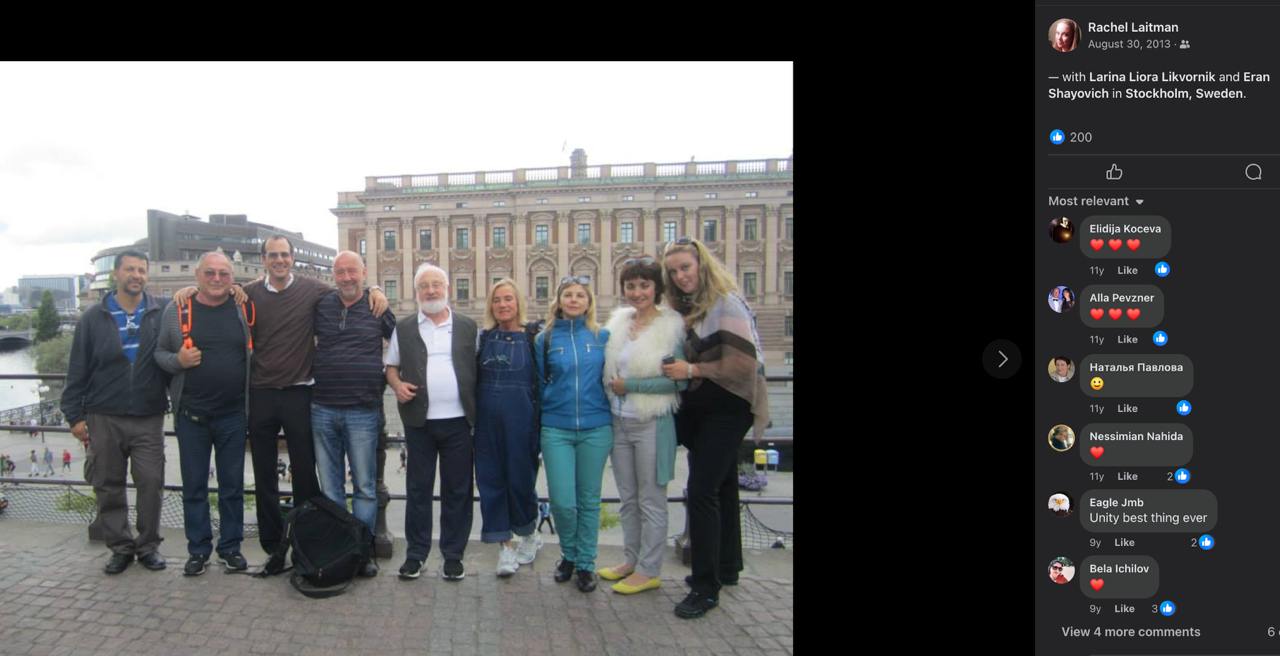
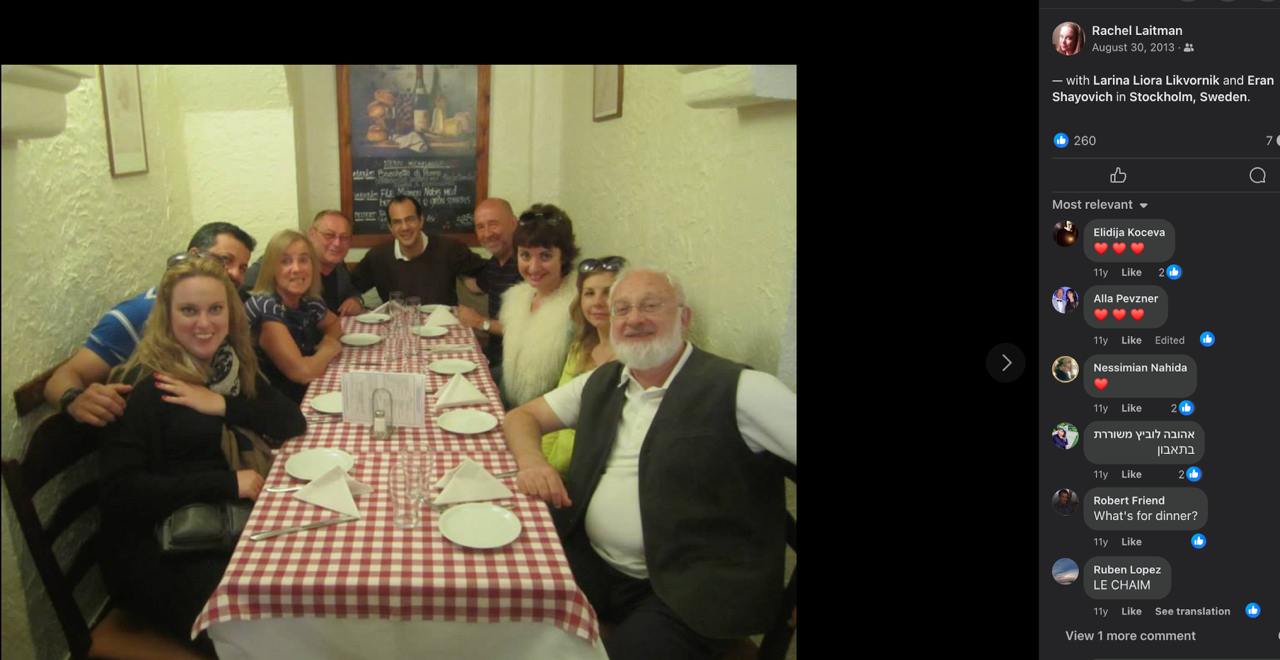
Natalia Oborina is an exception of another kind: access to Laitman himself. Publicly, Michael Laitman is presented as a spiritual teacher surrounded by distance, especially strict for women. Photographs show that for Oborina, a different rule operated: she accompanied the leader, stood near him, approached closely. An ordinary female student pays for such a step with her place in the cult, and before that spends years in fear of taking it by accident.
One photograph proves only what the frame contains. A series of images taken in different countries proves something else: who is allowed to break distance. In a place where closeness to the leader is status, these scenes operate as public ranking. Some remain in the hall. Others get a place beside the body of power.

At the congress in Sochi, Laitman allows a female student to hug him, and in the evening she comes to his room “for spiritual practices.”
The photograph shows Laitman embracing a woman, which directly contradicts the image of a religious leader around whom strict distance rules are declared for others.
The frame above shows what the declared distance rules are worth. Alongside slogans about spiritual equality stands an unofficial queue: whom the inner circle will let in, who may be embraced, who may travel with him. Laitman is here a cynical hypocrite: he declares distance for others while abolishing it for himself, does this in front of witnesses, and knows no one will say it aloud.

Laitman hugs a student from Latin America. Against the rules of distance declared for everyone else, this public gesture becomes a display of exception: next to the leader a different measure of closeness applies. What is framed as a boundary for the hall becomes a privilege for the inner circle.
Rules for the Majority, Exceptions for Close Associates
To outside audiences, Bnei Baruch speaks the language of spiritual work, modesty, and control over egoism. Inside the same cult live paid figures with de facto immunity and women with special access to the leader. To demand humility from students and keep untouchables at your side is impossible.
Moral demands are aimed downward, at those from whom obedience, sacrifice, and control over their private lives are expected. Above operates a different order: how useful a person is to Laitman and his inner circle. Useful, and the rules disappear. Stop being useful, and they return in full.
Beside Laitman in the photograph are women from his inner circle, Natalia Oborina among them. The informal closeness and internal exclusivity here are not a lapse but a regime: the rules of distance Laitman declares for everyone else, he cancels for his own.
This cannot be explained as accident. We face not a series of awkward photographs but a working order with three acts: whom to bring in, whom to cover, whom to remove.
The family and managerial cover structure
Exceptions around the leader cannot survive on their own. Someone pays salaries, distributes roles, controls congress logistics, and manages reputational damage. In Bnei Baruch, this apparatus is visible beside the account of the privileged life of the management circle and the religious frame that declares public rules.
In the story of Belyatsky and Oborina, the main figures are not them. Who kept Belyatsky on salary? Who decided which women get brought to Laitman? Who determined which rules bind the majority and which cancel for insiders? The answer is one: the cult is built as Laitman’s single-person structure, and a filter works with his knowledge and for his benefit. Between him and a vulnerable female student stands a layer of people who screen admission in advance, declare it normal, and remove his risk. The student gets pressure, fear, and the loss of everything at once.
Photographs, connections, and patterns of access say more about this environment than any official text. Rules exist for the hall. Exceptions exist for those needed by Laitman.
Access and intermediation as a mechanism
From here everything said converges into one line: the authority of Laitman and the work of intermediaries produce a single outcome, access to the body.
A place beside the leader is handed out as status, not earned by rules declared for the rest. Spiritual authority is the lever here: “sexual access under the guise of spiritual status” stands as a separate documented marker in the list of cult-control markers, not a private episode.
Five women testified about Laitman’s sexual violations, and their accounts were collected separately: police, court, an attorney who drew up an affidavit, an Israeli center for victims of cults, and different publications ranging from TheMarker to The Seventh Eye (summary of complaints). From these separate testimonies emerges the same pattern: spiritual status first works as a reason for closeness, then as a lever of pressure. Katya and Mona describe it. High-ranking members of the cult remained unnamed in these testimonies. They remain unnamed here.
Levels are kept separate not for softness but for strength. What Laitman states on video stays his own doctrine. The procedural part remains suspicion. The line of Belyatsky and Oborina stands on testimony known to the editorial team. The scattered scenes of access are not coincidence but a recurring scheme in which intermediation and spiritual status work as a pass to the body of power.