Michael Laitman: Pseudo-Kabbalist, "Science" of Irrational Consciousness and the Rule of Kabbalists
Where you are in the dossier: Control mechanics Mixed evidence
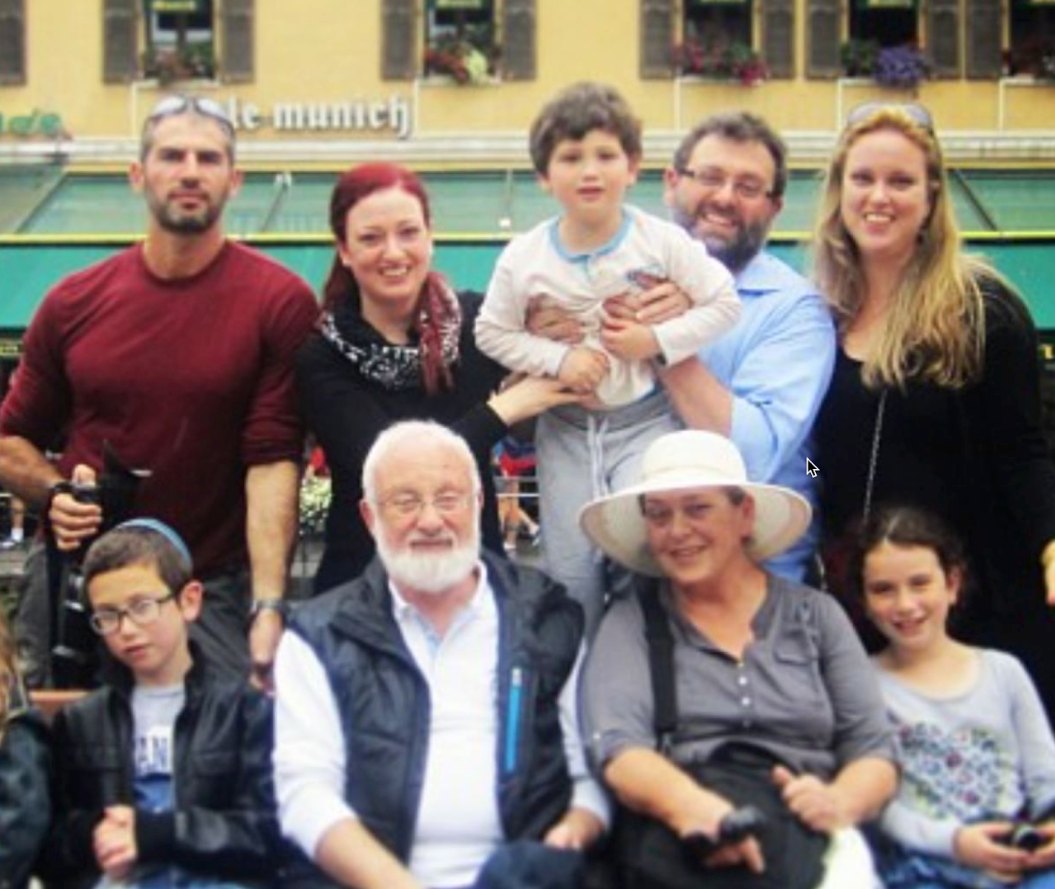
Michael Laitman markets a single authoritarian system under three different names. He calls mysticism science: his candidate dissertation, defended in Moscow in 2004 in specialty 09.00.13, is titled “Kabbalah as a Form of Irrational Consciousness”, 202 pages on a subject the author himself defines as irrational. He renames the rule of kabbalists mutual guarantee. Unpaid labor inside the cult is concealed behind the same spiritual vocabulary: a mother writes that her daughter has been in the cult for about ten years and worked extensively for it without pay, while invoking Laitman’s own slogans about unity and reducing egoism.
To the outside world, Laitman presents unity and mutual guarantee. In his 2006 book “The Last Generation,” he spells out where it ends: kabbalists head every committee and every channel of power, their decisions cannot be challenged, and majority opinion loses all meaning. He writes both texts.
The Israeli press first sounded the alarm in 2009: The Seventh Eye wrote outright that the real cult journalism should have been covering was not the television sensation around Goel Ratzon, but Bnei Baruch under Laitman, “apparently the largest cult in Israel.” Fifteen years later, The Seventh Eye records Bnei Baruch as already the country’s largest new religious phenomenon: tens of thousands of followers, real estate in central Israel, its own TV channel, a publishing house, a translation industry, and a deliberate push into politics. In July 2025, TheMarker reported that the cult’s former lawyer, Hanoch Milwidsky, was questioned under caution, on suspicion of obstruction of justice and rape. Five women testified to sexual violations by Laitman himself; he was not questioned. How the complaints were blocked and lost is covered in the summary of testimonies.
“The Science of Kabbalah” Facing Academic Scrutiny
The claim to scientific rigor was scrutinized even before academia stepped in. On February 15, 2009, The Seventh Eye wrote that Laitman presents his teachings as “science” even though they “fail every minimal scientific standard,” and that he is not a rabbi at all despite presenting himself as one. The column’s main charge was aimed at television: the program Uvda aired a light, fawning segment on Laitman, even though Bnei Baruch is “apparently the largest cult in Israel,” and several tens of thousands of followers in Israel and worldwide live under his control. His own followers attach the title “Rav”; the Kabbalah La’Am website and his book blurbs read: “Rav Michael Laitman, student and personal assistant of Rav Baruch Ashlag.” Haaretz August 22, 2012 recorded their acknowledgment: “even they acknowledge he never received rabbinical ordination, and the title of rav next to his name is only an honorary title.” The site calls him “professor of ontology and theory of being.”
Four years later, a peer-reviewed academic journal dismantled the same claim. The “Tomsk State University Journal” published an article in 2013 by Alexander Cherepanov titled “History and Kabbalah in the Concept of M. Laitman” (No. 372, pp. 144–147): “Laitman is not a professional historian. By training, he is a biocyberneticist.” The article identifies “a mystical-religious interpretation of historical events and a missionary orientation of the historical process.” The full text is publicly accessible.
Laitman dates the Zohar to the 1st millennium and attributes it to Rabbi Shimon bar Yochai; Gershom Scholem, founder of the academic study of Kabbalah, dated it to the late 13th century and linked it to Moshe de Leon. Cherepanov calls the claim that the book was destined to remain “concealed” until its appointed time scientifically unfounded. Laitman derives Lurianic Kabbalah, the Reformation, and technological revolutions from the growth of egoism and the work of kabbalists, which the paper characterizes as flawed, one-sided, and “ignoring economic, cultural, socio-political, and other factors.”
Six years later, the same author defended a candidate dissertation at Tomsk State University titled “The Historical Views of M. S. Laitman: The Mythological Component of Modern Historicism” (07.00.09, 2019, 242 pages), where “the problem of the scientific validity of Laitman’s approach to Kabbalah” is listed in its table of contents. The dissertation profile provides open access to the table of contents, introduction, and bibliography. In the introduction, a footnote cites Laitman’s own candidate dissertation: “Kabbalah as a Form of Irrational Consciousness”, 09.00.13, Moscow, 2004, 202 pages.
Biographical notes in Laitman’s books claim he graduated from the Leningrad Polytechnic Institute with a degree in “Biological and Medical Cybernetics.” Document photocopies analyzed in the introduction show he graduated from the North-Western Extramural Polytechnic Institute in 1971 with a major in “Electronic Computers” and the qualification of “Electrical Engineer.” The blurbs in his books and the official records do not match.
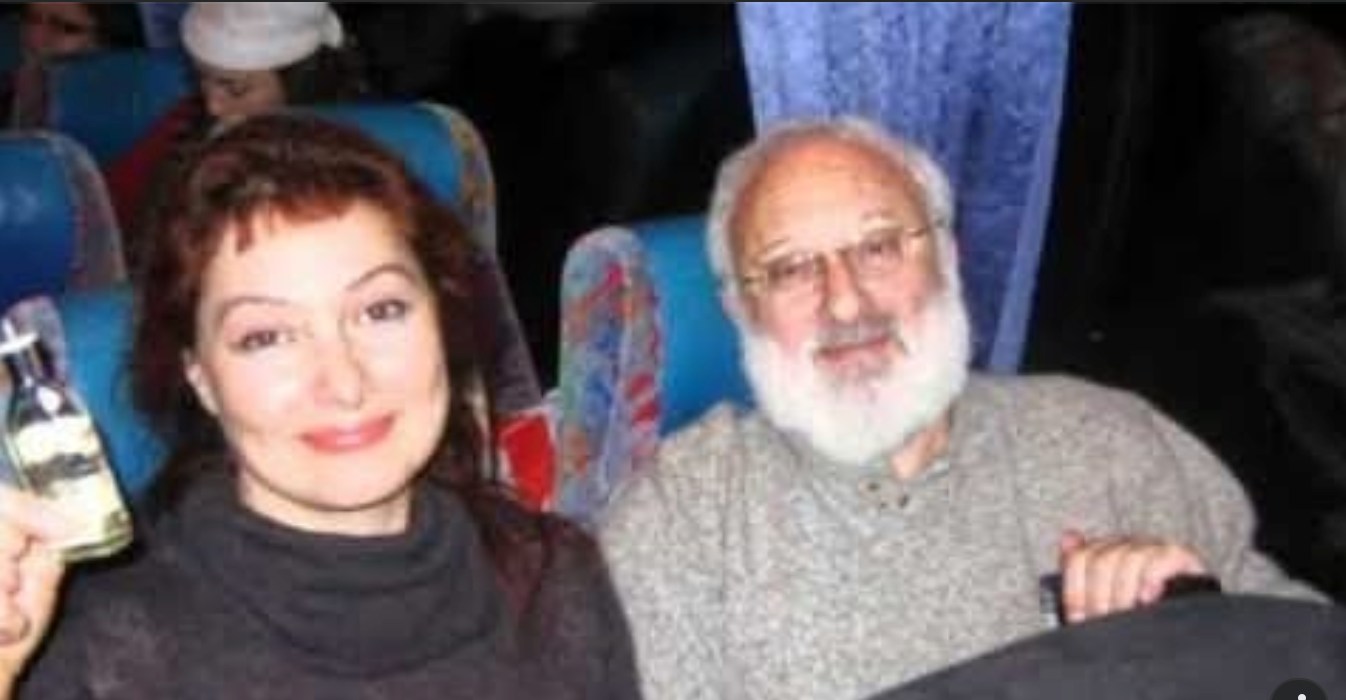
In the photo, Irina Yankovich was in a relationship with him and wanted to have a child with him; relying on her connections in the Russian Academy of Sciences, she helped him obtain a professor’s PhD diploma.
Four things converge: an extramural polytechnic diploma and “electrical engineer” in the record, a dissertation on irrational consciousness, a peer-reviewed article on a mystical-religious interpretation of the past and missionary work, and a 2009 column on failing the minimal scientific standard. The fifth is practice, and former members described it in sworn affidavits submitted to court and published by Ynet on March 4, 2016. Laitman distributes homemade pills as curative. Maxim Diamandi: “Laitman talks about himself as a possessor of superpowers… For example, he hands out pills that he made himself.” A woman Ynet calls “Anna” (name changed) fell into depression during her first pregnancy: “Laitman gave me medicine that was supposed to cure the depression. The medicine was candy used to decorate cakes. Of course, it didn’t help.” He “treats” a depressed pregnant woman with confectionery candy. The conclusion is direct: Michael Laitman is a religious charlatan peddling mysticism under the banner of science.
A footnote in the same dissertation records that the Israeli television channel “Kan” investigated Bnei Baruch and “accused Laitman of insincerity, cultism, total control over the activities of his followers, complicity in the destruction of family relationships of his followers, contempt for women, and concealment of problems among his followers (cases of suicides and persecution of disobedient students).” The accusation is addressed personally to Laitman. The cult’s response was: “Official response of the association ‘Bnei Baruch-Kabbalah LaAm’ to the broadcast of the full version of the ‘investigation’ by the Kan corporation,” with the association placing quotation marks around the word “investigation.” Both documents carry the year 2017. The catalogue of accusations was already in the public domain, and the response to it was a denial, not a refutation.
Students pay the physical cost of this facade. Inside the cult, it translates into routine: waking in the middle of the night, lessons from three to six in the morning, and commuting to work without sleep. How this regime is assembled is covered in the breakdown of the path into the cult. This is what students look like after such nights. See also the cult’s internal regulations.

In the photo are Grigory Shilin and Michael Miller, students of Laitman. After such a night and such sleep, these people continue on their way to work; it is not without reason that several students have died on the roads after Laitman's lessons.

These two photographs directly visualize the cost of participation: lack of sleep, the congress routine, and the body as a resource of the system.

These people are expected at their regular jobs in the morning. Outside, at the entrance to his center, the public writes about Laitman differently:

In this photograph, people are protesting at the entrance to Laitman's center with signs reading: "Laitman and Milwidsky = concealment of sexual harassment and assistance in a state coup."
“Arvut” for the 99 Percent
In the summer of 2011, as Israel took to the streets in tent protests, the cult launched a dedicated public brand: “Arvut” (Mutual Guarantee). Laitman announced this directly on his personal blog: “The ‘Arvut’ Movement was founded by the ‘Kabbalah LaAm’ Movement.” At demonstrations, Arvut activists showed up with posters that, as religious scholar Tomer Persico noted, lacked any recognizable Kabbalistic markings.
The mechanics were documented by cult researcher Shay Ben-Tal in an interview with Persico on August 22, 2011. Six months before the protests, an initiative began under Laitman’s leadership to reach the “99 percent,” those whom, by Baal HaSulam’s own standard, Kabbalah was never meant for. The approach had to be indirect, as free of threat as possible, with no words like “correction,” “Creator,” or “Kabbalah,” only simple, utilitarian concepts: how Kabbalistic ideas could benefit the individual.
A grassroots initiative became an organized operation. Field activists asked for guidance, and leadership began distributing clearer messaging. Ahead of the August 6 rally, phone operators at Kabbalah LaAm centers called members. The Petah Tikva center produced instructions on conduct and the slogan: “Neither left nor right, mutual guarantee above all.”
The link between “Arvut” and the cult was noticed even earlier. On August 8, 2011, blogger Hanan Cohen described the most organized bloc at the protests: printed T-shirts, ready-made signs, funding, and mobilization capacity; a reader tip led him to Laitman’s blog post. That same day, the blog “Minim” republished the finding: a single observation and its report, not two independent investigations.
Kabbalah LaAm created the brand. The audience was chosen in advance: the “99 percent.” The words “correction,” “Creator,” and “Kabbalah” were purged from the conversation with it. Leadership drafts the messaging. What goes out is a harmless “mutual guarantee.” The same device is recorded in the cult’s internal instructions for online commentators, which reached Haaretz in 2012: “don’t ‘poke the eyes’ with the word ‘kabbalah’ specifically; the main thing is that kabbalah’s messages get through.” This is fraud: people are sold Laitman’s kabbalah while the word “kabbalah” is hidden from them.
“The Last Generation”: Power Beyond Appeal
Shortly before the Arvut posters appeared, Laitman himself described the outcome of the global process: “Towards a world government… The general government will be a government of sages, unified without division between great and small.” Persico notes that a similar structure appears in Laitman’s 2006 book “The Last Generation.”
On December 18, 2024, The Seventh Eye described the Bnei Baruch cult as “the largest and most successful new religious movement in Israel”: tens of thousands of members in the country and tens of thousands more abroad, real estate in central Israel, a TV channel, a publishing house, and a deliberate push into politics. The program of this machine is spelled out in “The Last Generation,” and the outlet quotes it in detail: kabbalists who have attained spiritual perception “will stand at the head of all committees and all channels of authority in society, and they will determine who continues on the path. There will be no possibility of appealing their decisions or replacing them. The concept of ‘majority opinion’ will not be relevant in this society in its simple sense.” Admission, by Laitman’s own criterion, requires understanding the necessity of submission to kabbalist leadership and willingness to obey it as a higher power.
This is a published political-religious program, and its author is Laitman. Under his direction, “Creator” and “Kabbalah” disappear from outreach to the street. Outsiders get mutual guarantee; members, power with no procedure for replacement. Laitman wrote a program of totalitarian power: it cannot be challenged or replaced, and majority opinion decides nothing within it.
This ideology did not stay separate from politics. An investigation by Shakuf and The Seventh Eye on December 18, 2024 revealed an organized presence of cult members inside the Likud party and operations through party apparatuses. The analysis is in the article on the 50-million-shekel bill.
The Cost of Participation and Fear of Reaction
Aaron Appelbaum, a parent with a child inside, turned to the state: he wrote to the Ministry of Education that Laitman’s structure is a cult. Bnei Baruch responded with a defamation lawsuit. Two outlets wrote about the lawsuit, independently of each other. Ynet on March 4, 2016 covered it as the case from which affidavits by former members emerged. The Seventh Eye on October 25, 2017 covered it as one of the lawsuits by which the cult shuts down criticism, and by then the case had been running for four years. The plaintiff’s line in Ynet: Appelbaum defamed the nonprofit with libelous publications, and he himself is “a wealthy businessman who devotes all his efforts, his time and his money, from personal motives, to finding fault in the activities of the nonprofit.” The suit answers the complaint by attacking Appelbaum. Appelbaum’s attorney Ishai Shnidor responded in the same report: “This lawsuit is legal intimidation designed to scare people away from acting against them on the public stage.” That is the defense’s position.
The same case shows whom the cult trains to stay silent. The Seventh Eye lists Appelbaum’s co-defendants: the communications consultant he had turned to; the owner of the company that built the lawsuit’s website; the firm on whose servers that site simply sat. Listed separately: former members who had publicly criticized the cult. A lawsuit like this is intimidation: the defendant becomes anyone who helped the criticism be heard, down to the hosting provider. The nonprofit is named as plaintiff, but the newsroom has learned that no significant action by the cult happens without Laitman’s command or approval. He wrote the book in which kabbalist decisions cannot be appealed.
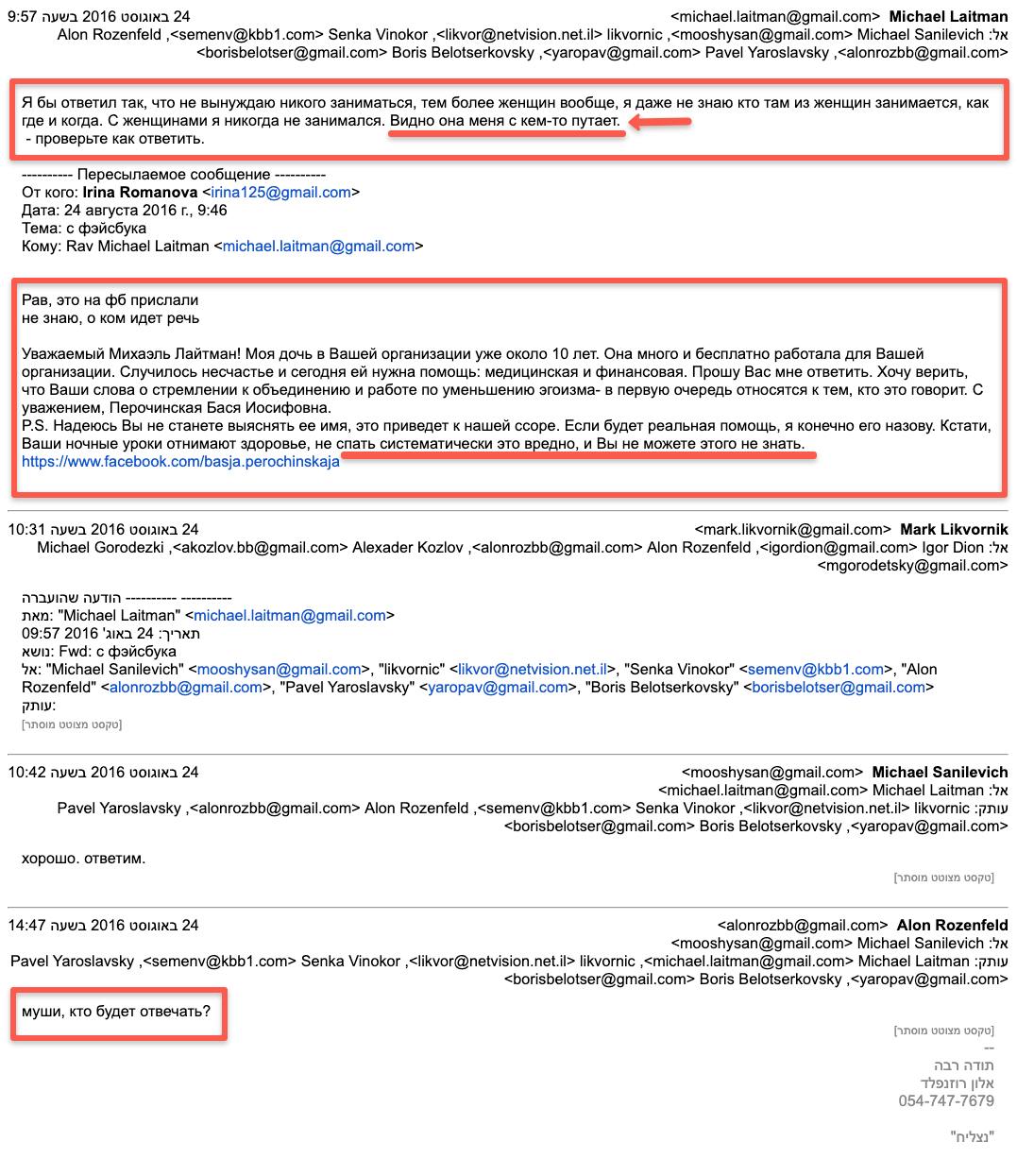
Basya Iosifovna Perochinskaya wrote directly to Laitman. According to her, her daughter has been in the cult for about ten years and worked extensively for it without pay; when misfortune struck, her daughter needed medical and financial help. The mother threatens neither lawsuits nor the press; she asks for help in Laitman’s own vocabulary of striving for unity and reducing egoism:
"Rav, this was sent on fb I do not know who this is about
Dear Michael Laitman! My daughter has been in your organization for about 10 years. She worked a lot and for free for your organization. A misfortune has happened and today she needs help: medical and financial. Please answer me. I want to believe that your words about striving for unity and working to reduce egoism apply first of all to those who say them. Respectfully, Perochinskaya Basya Iosifovna.
P.S. I hope you will not start finding out her name, this will lead to a quarrel between us. If there is real help, of course I will name her. By the way, your night lessons take away health; systematically not sleeping is harmful, and you cannot fail to know this. https://www.facebook.com/basja.perochinskaja"
In the correspondence there is no direct reply to the mother. She is afraid to name her daughter: “I hope you will not start finding out her name, this will lead to a quarrel between us”; she will give the name only if genuine help is offered. The same letter tells Laitman about the night lessons: “systematically not sleeping is harmful, and you cannot fail to know this.” How a personal plea inside the cult becomes internal administrative traffic is shown in the email leak “How Should I Go On Living?”.
Leaving the Zone of Responsibility
The mother’s appeal (her daughter, ten years in the cult, extensive unpaid labor) goes up the internal management chain. In work correspondence copied to Laitman’s personal address, it is reduced to:
“Mushi, who will answer?”
Later in the thread, staff member Irina Romanova proposes a draft reply in the first person, in Laitman’s name:
“I would answer this way: I do not force anyone to study, especially women. I do not even know what women study, where and when. I never taught women. She is probably confusing me with someone else.”
No clarifying question, no request to look into it. The mother writes to Laitman about his night lessons, and Romanova’s draft answers in his name: “I never taught women.” Laitman’s night lesson at his center in Petah Tikva was described by Haaretz on August 22, 2012: “Women don’t come here, they watch the lessons from home.” The reply issued in his name is a lie, and a cynical one: ten years of her daughter’s life in the cult and years of unpaid labor are closed off with the formula “confusing me with someone else.”
When a Person Is No Longer Needed
One device runs through the whole correspondence: translation into the cult’s language.
A dissertation on irrational consciousness was sold as science; the authority of kabbalists over every committee and channel of power, as mutual guarantee. Ten years of a mother’s daughter in the cult and years of unpaid labor were sold as unity and the reduction of egoism. The transaction flows one way as long as the member gives. As soon as help is requested, the facade vanishes: the draft reply reduces the plea to “confusing me with someone else.” Michael Laitman trades in unity only until unity demands anything from him.