Five Women Against Laitman: How the Cult and the Police Silence Testimony
Where you are in the dossier: Harm and testimonies Mixed evidence
Bnei Baruch Investigation · Entry point · Part 4 of 4
Hanoch Milwidsky was questioned under caution on suspicion of rape and inducing a witness to lie in her testimony. His teacher, Michael Laitman, had not been questioned even once as of August 2025. Five women testified about sexual violations on his part, and taken together, according to TheMarker (August 8, 2025), those testimonies make him the primary suspect. Laitman is a religious predator, shielded twice over: by the cult apparatus from inside, by police inaction from outside. It is the student they question.

A complaint filed in spring 2025 was lost by the police. Complainant “G” (TheMarker), who had left the cult, wrote from abroad about a series of sexual assaults by its leadership, above all by Laitman himself; a police officer confirmed in writing that the complaint would be forwarded to the investigations department. “G” was never called in for questioning, and after TheMarker’s inquiry the filing could “not be found.” The outlet had to show the police confirmation that the letter had been received.
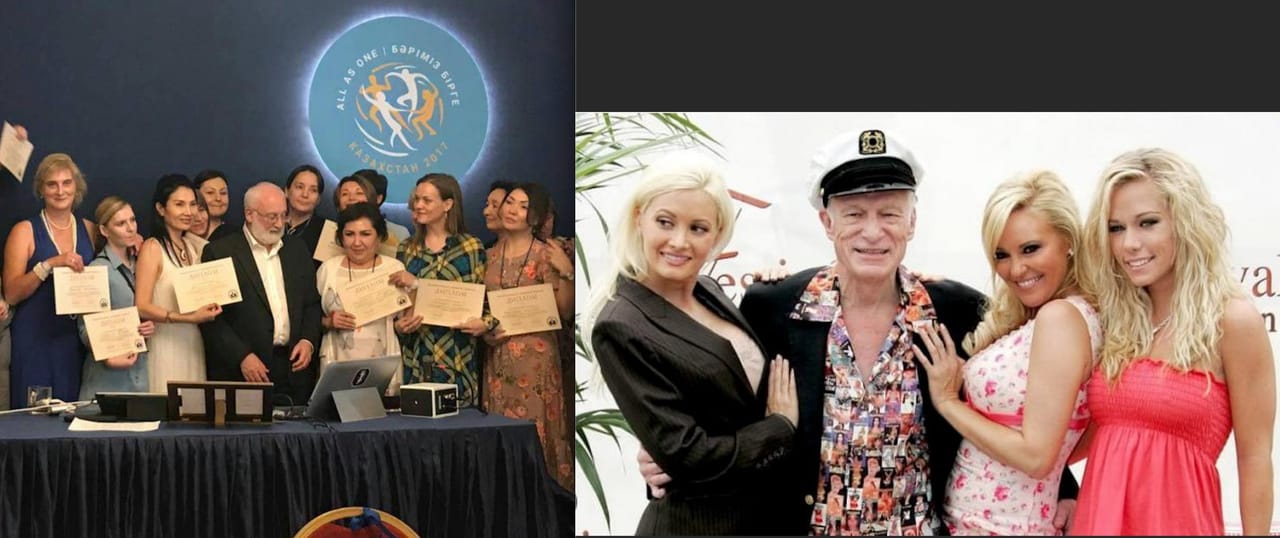
Women at the “Bnei Baruch” congress in Kazakhstan. This shot shows a large female environment and an atmosphere of “unity,” within which workshops (sadnaot) were presented as a practice of connection, alignment of speech, and submission to a shared framework.
The earliest testimony was buried in the mid-2010s. Complainant “B” signed an affidavit: at congresses she was summoned to the room of Laitman, a man decades older, and slept with him several times out of fear that the spiritual leader would reject her; in the affidavit, contact with him is called “disgusting to me.” She gave a filmed interview, then buried both the affidavit and the interview, explaining to acquaintances that her relatives abroad had been visited by threatening guests. The newsroom knows this woman’s identity, and her testimony is detailed in a separate article on Katya Sukhova.
The complaint about those threats was brought to police by the Israeli Center for Victims of Cults. Instead of investigating the men who went to the complainant’s relatives, police pursued a journalist and demanded the tape of the buried interview. Judge Oded Moreno refused, ruling that journalistic privilege prevented disclosure. The refusal protected the source, not the substance of the accusations. The threats were never investigated.
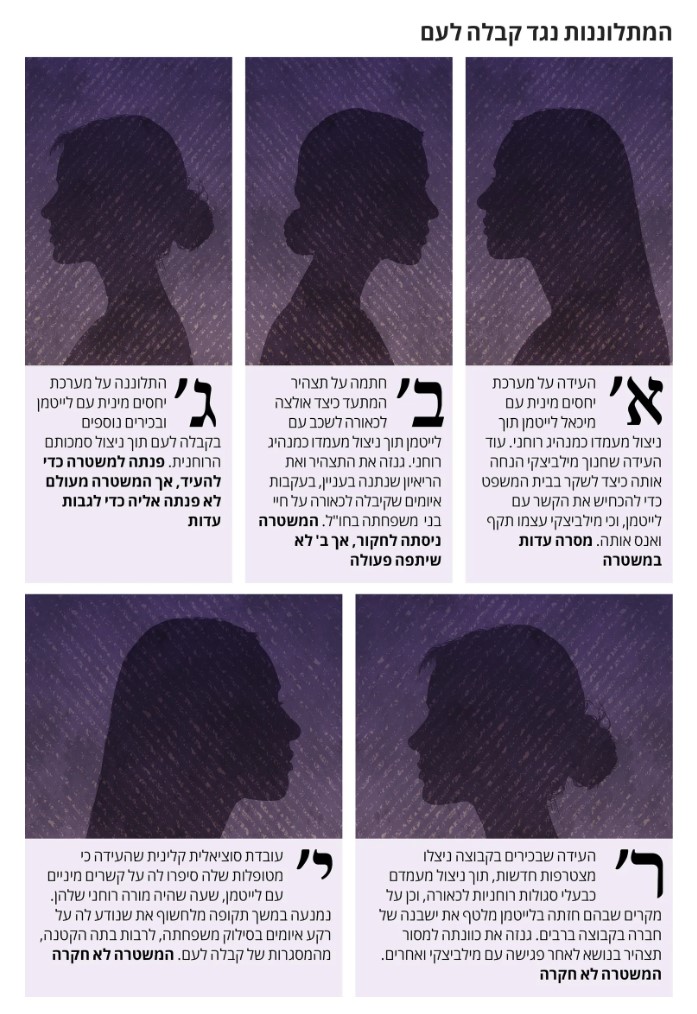
Complainants against "Kabbalah La'Am"
א׳
Testified about a system of intimate relationships with Michael Laitman, using his position as a spiritual leader. She further testified that Hanoch Milwidsky instructed her how to lie in court in order to deny a relationship with Laitman, and that Milwidsky himself attacked and raped her. She gave testimony to the police.ב׳
Signed a declaration documenting how she was allegedly forced to enter an intimate relationship with Laitman through the use of his position as a spiritual leader. She concealed the declaration and the interview she gave about it because of threats she allegedly received against the lives of her family members abroad. Police tried to investigate, but B did not cooperate.ג׳
Filed a complaint about a system of intimate relationships with Laitman and other senior members of Kabbalah La'Am, using their spiritual authority. She contacted the police to give testimony, but the police never contacted her to take her testimony.ד׳
Testified that senior members of the group exploited new joiners by using their position as people who allegedly possessed spiritual abilities, and also about cases in which she saw Laitman stroking the buttocks of a woman in the group in public. She withdrew her intention to submit a declaration about this after meeting with Milwidsky and others. Police did not investigate.ה׳
A clinical social worker who testified that her patients told her about intimate relationships with Laitman while he was their spiritual teacher. For some time, she refrained from disclosing what she had learned against the backdrop of threats to exclude her family, including her young daughter, from Kabbalah La'Am frameworks. Police did not investigate.
Complaints That Did Not Move on Their Own
Witness “R” was intercepted on the eve of signing. A draft affidavit prepared with attorney Carmel Pomeranz documented the men of the “inner circle,” whom visiting women take to hold the highest spiritual rank, and three separate instances when she witnessed Laitman stroking a cult member’s buttocks in public. The day before the planned signing, she wrote her lawyer: Bnei Baruch had called again, offering a meeting with Hanoch, Parovoz, and Mushi. “Do you think this is a trap?” Contact ended, and the draft was never signed. Pomeranz’s complaint about witness tampering went nowhere.
At a hearing on January 18, 2023, journalist Gur Megiddo told the court about a complainant whom The Seventh Eye designates “K.”: she had set out her testimony in an affidavit, then withdrawn it. The newsroom has learned that “K.” is Katya Sukhova. By law, he explained, that document could not be relied on until the woman who gave it underwent cross-examination; she was never questioned, because she had been threatened with violence. He said he had seen the evidence of those threats himself: she had been sent the addresses of her relatives (The Seventh Eye). In Megiddo’s account, because of the threats the testimony never reached scrutiny in court.

David Sakiyan, a former Laitman follower, told The Seventh Eye that in 2016 Milwidsky prevented his then-wife from filing an affidavit charging Laitman with sexual assault. And by that same affidavit of Sakiyan’s, filed in one of Bnei Baruch’s lawsuits, the next round of pressure came not as a threat but as generosity: his family in crisis was invited to come to the cult’s house in Petah Tikva every midday and take “as much food as she wants for the family,” and a lawyer Milwidsky knew was brought into his criminal case free of charge. “It was clear to both of us that he was buying our silence so we would not come out against Bnei Baruch and would not testify against them,” Sakiyan wrote, and in the same place he was precise: “He did not say it outright, but it was clear this was not out of kindness.” The same mechanism, turned inside out: a witness can be silenced without being frightened. See also the dossier methodology and help for those affected and the timeline of Laitman’s cult.
Ilanit Yezersky is a clinical social worker who left “Kabbalah La’Am” in Petah Tikva several years ago. The cult was everything for her all at once: neighbors, clients, her income, and her entire family’s life (TheMarker, Bizportal). Several women confided to her that they were sleeping with Laitman as part of an effort to reach higher spiritual levels. She demanded a meeting with Laitman himself, and according to her account, he admitted his transgressions and promised to reform.
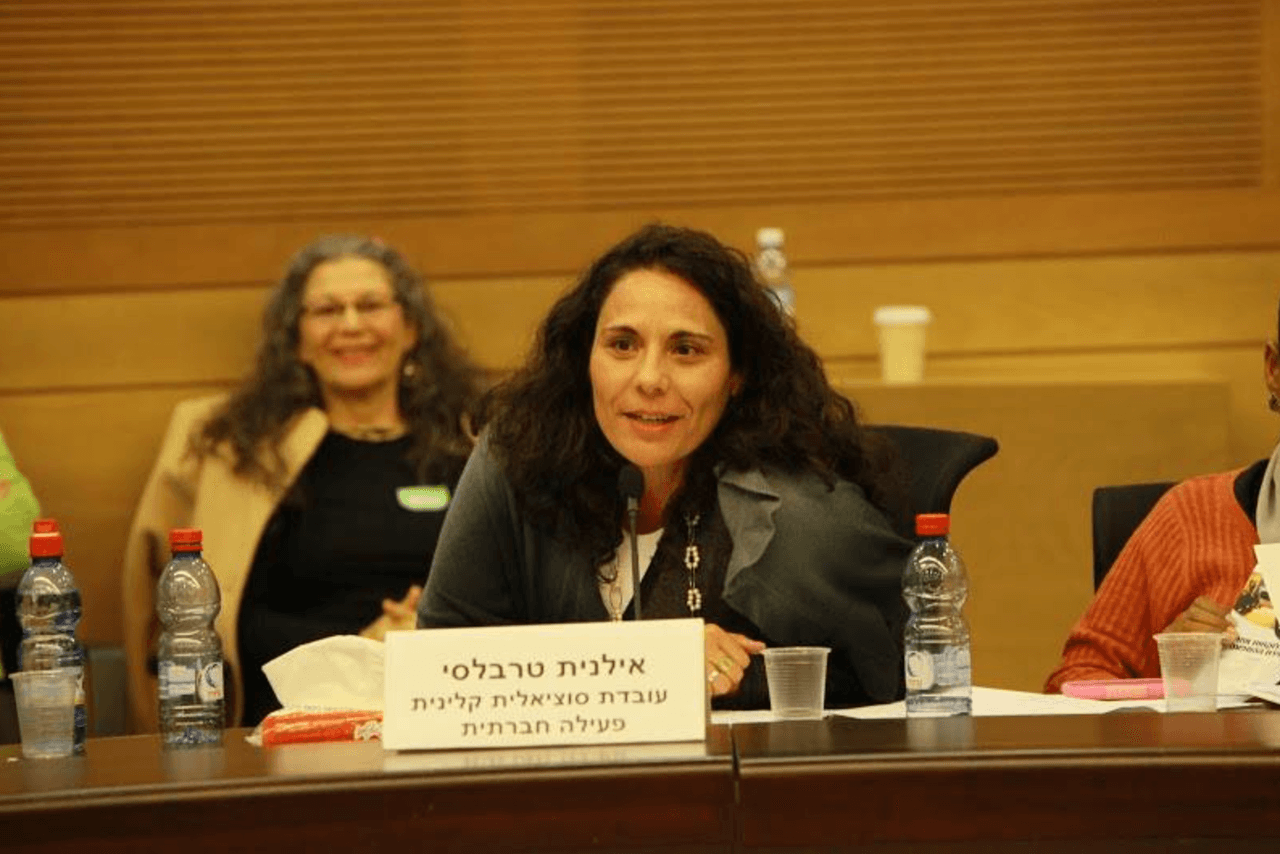
Pictured is Ilanit Yezersky, a clinical social worker to whom Laitman admitted that he has sexual relations but does not harm his female students.
She retold that same conversation in court: in September 2022, Yezersky testified at the Bat Yam Magistrate’s Court, before Judge Azaria Alkalay. The Seventh Eye quotes it verbatim: when she told Laitman to his face that she knew about his relationships with women who were not his wife, he first denied it, then admitted: “I haven’t harmed anyone.” Hearing about his own wife and children, he agreed: “Yes, you’re right, I did cause harm. What do you suggest I do?” And when advised to get treatment, he laughed: “I’m already old.” Yezersky told of that admission twice: to journalists and to the court.
There was no one inside the cult to complain to. At that same hearing, Bnei Baruch’s human resources director Tahel Shadmon, formally responsible for preventing sexual harassment, answered under cross-examination by attorney Yuval Yoaz when asked what she had done about the grave accusations against Laitman: “I did nothing.” The family route of that complaint is detailed separately.
Outside the cult, “K.” was heard. At the hearing on January 18, 2023, Rachel Lichtenstein, general director of the Israeli Center for Victims of Cults, testified that back in 2016 “K.” had come to them and described how Laitman had drawn her into an intimate relationship; her consent had been compelled by his authority and her fear (The Seventh Eye). The center’s clinical director spent hours verifying the account. Laitman’s treatment of women, in Lichtenstein’s assessment, is emulated by other men in the cult.
The cult got to Yezersky through her child. She knew what was happening from her own patients and stayed silent for a time: her family faced expulsion from “Kabbalah La’Am.” The family had entered the cult when their daughter was seven. By the time of the boycott she was twelve; she lost all her friends at once and begged her parents to return. An organized boycott of the child became the cult’s way of forcing the mother into silence (TheMarker, The Seventh Eye).
Alesya, Gelman’s Office, and Legal Support
One court version was substituted in advance. In statements signed before a lawyer, Alesya describes how the lie for court was prepared. As retold by The Seventh Eye from Binyamin Rafaeli’s affidavit, Tzvi Gelman, who for more than ten years had run the cult’s litigation campaign, was present at the briefing, and Eli Vinokur translated the explanations. What matters here is the outcome: the victim’s testimony was to be turned into a defense for Laitman. The intermediaries’ roles and their responses are examined separately.
Why “Consent” Does Not Work Here as a Concept
Israel’s Penal Code, as TheMarker explains it, singles out a distinct offense: sexual relations between a minister of religion and a person receiving his counsel or instruction. The law defines a minister of religion, among other things, as someone who “presents himself as possessing special spiritual properties.” Laitman has presented himself this way since the 1990s and, per the same outlet, answers any question: on geopolitics, on intimate life. Women came to him for guidance, and the same years of dependency and unpaid labor for the cult precede Mona’s testimony, Katya Sukhova’s account, and Alesya’s story.
Victim “A,” Alesya, told Channel 12: “He built individual relationships with each woman to achieve spiritual enlightenment.”
A Structure with Political Cover
For almost ten years, allegations of sexual assault inside the cult were ignored by the police, by TheMarker's assessment. Police and press did not move against the cult in earnest until after an election: Milwidsky, then legal adviser to “Kabbalah La’Am,” took 26th place on the Likud list, a slot won with fewer than five thousand votes, on the votes of a cult enrolled in the party in advance and in an organized wave. Attention arrived with the Knesset seat, not with the women’s testimonies.
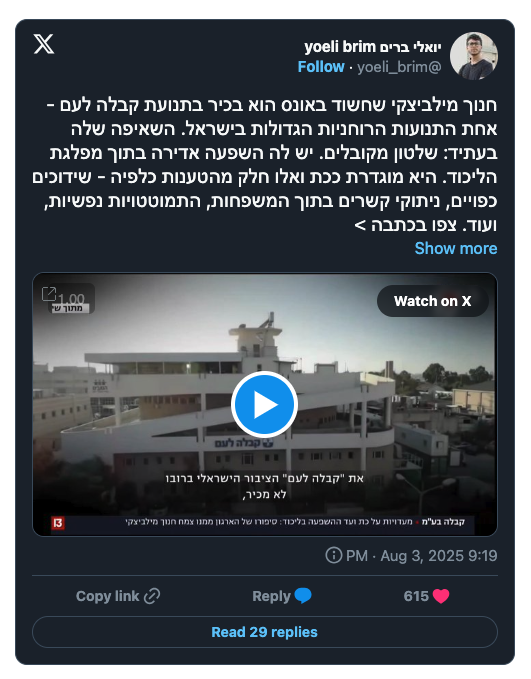
In summer 2025, suspicion reached the cult’s legal adviser and educator: attorney Tzvi Gelman and Dr. Eli Vinokur, on suspicion of inducing a witness (Haaretz, Ynet; per Binyamin Rafaeli’s affidavit, The Seventh Eye); neither is suspected of sexual crimes (News1, The Times of Israel). The roles and the course of the interrogations are analyzed in the procedural-node article.
August 11, 2022. Omri Maniv. Testimony of “A”
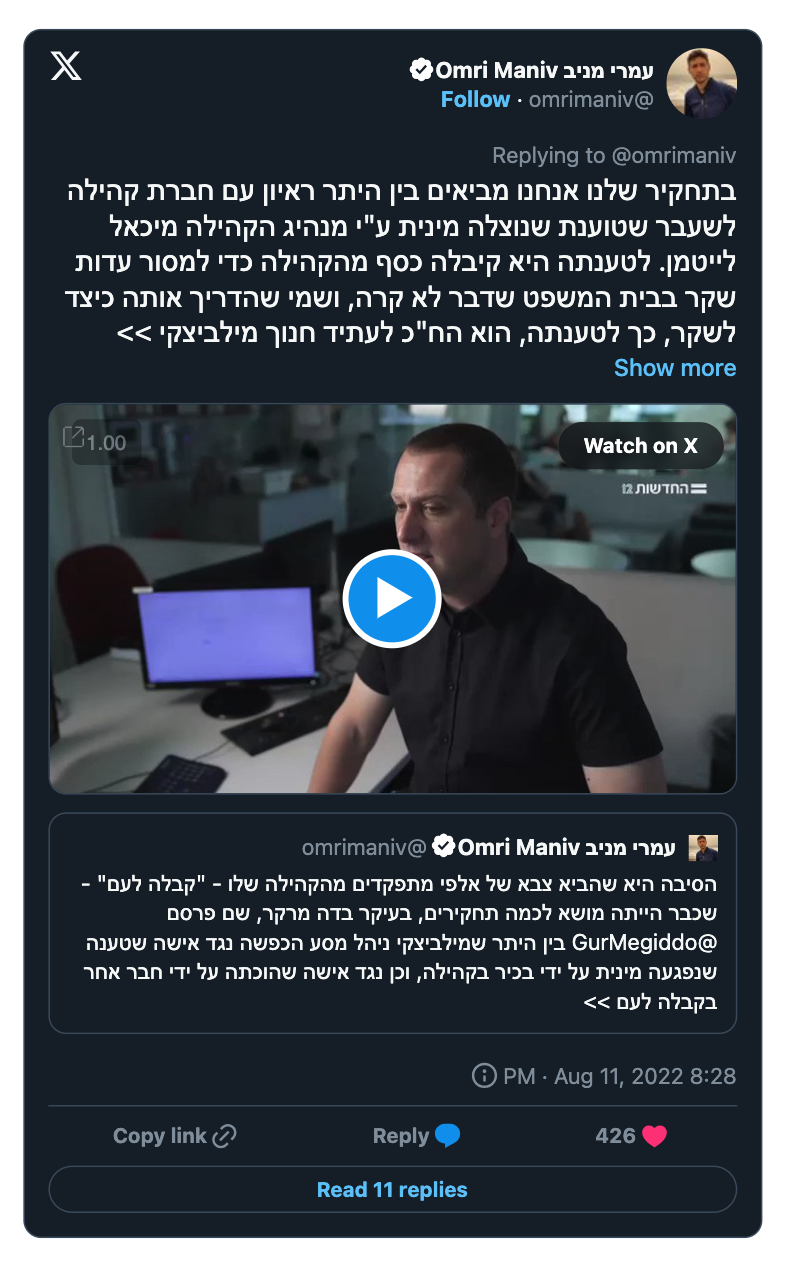
On August 11, 2022, the day Milwidsky won the primary, journalist Omri Maniv published a four-post thread on X. He attributes the backing of almost the entire Likud leadership to one thing: an army of thousands of registered party members from the cult. Then comes the announcement of an interview with a former member. According to her, Laitman sexually exploited her and she received money from the cult for false court testimony that nothing happened; Milwidsky was the one who instructed her to lie.
The fourth post in the same thread is a denial. Laitman and Milwidsky categorically reject these claims and note that the same woman signed, on two different dates, affidavits confirming their version. Accusation and denial came from the same author minutes apart. The thread is reproduced in full here. The cult’s defense rests entirely on that signature, the one the woman says she gave for money and on instruction.
Four years earlier, Rina Ben-Ami recorded Kabbalah La’Am’s legal adviser on a hidden camera declaring that complainant “B”'s testimony was bought “even for 100 thousand euros,” offering no evidence; the recording is analyzed in Milwidsky’s profile. It is one tool pointed both ways: when a woman says she was paid for silence, the cult responds that someone else paid for her words.
A month later the cult filed suit, not against “A,” Omri Maniv or News 12, but for 2.87 million shekels against Binyamin Rafaeli, a bodyguard who confirmed her account on air. The filing calls the testimonies of abuse an “extortion attempt,” and in a cynical inversion the cult recast their circulation as “sexual harassment” of its own female students. The pressure now arrived as a claim form. It attached no evidence (The Seventh Eye).
Testimony from “A” did, in the end, reach the investigation: in summer 2024 a LAHAV 433 delegation travelled to Moscow and took her statement; in summer 2025 police questioned Milwidsky, Gelman, and Vinokur.
Laitman was never questioned.
The first of the five testimonies dates to the mid-2010s, the last to spring 2025. In August 2025, police told TheMarker that the 2018 investigation had been completed and the case closed by prosecutors, and that a “review” was now under way in light of the new information. Of the five women, by that point police had taken testimony from only one: “A.” The police’s response says not a word about Michael Laitman, Milwidsky’s teacher.
The newsroom is continuing its investigation. If you have information about these events, or if you were yourself a participant or witness, contact us.