Katya Sukhova vs. Laitman: "I Just Waited for It to Be Over"
Where you are in the dossier: Harm and testimonies Testimony
Bnei Baruch Investigation · Entry point · Part 1 of 4

In 2014 Michael Laitman, according to the signed testimony of Katya Sukhova, used her faith in him as the only “channel to the Creator” to get her to have sex with him. Katya recorded: “For me it was revolting. I just waited for it to be over.”
Katya signed the testimony under her own name. Her email katia.soukhova@gmail.com, phone number +33652447883, and public Google Maps profile with reviews are publicly accessible.
Katya set down her testimony in writing and signed it in the presence of a lawyer. This is a primary signed first-person testimony: every serious claim below stands under the frame “according to the signed testimony.” The original is in Hebrew. The document was never submitted to court: after threats against her and her family, Katya refused to testify against Laitman.
2011. France. The Douiev Coordinators
According to the signed testimony, in 2011 in France Katya enrolled in a Bnei Baruch distance learning course. Morning lessons and collective study displaced everything else in her life. The belief everything later rested on was not hers to invent: she was taught it. Laitman taught that the Creator can be felt only through Bnei Baruch, and any wrong thing a person noticed inside it he explained as a flaw in the person who noticed it. Later, in private conversations, he told her, by her account: “I am only the one who will bring you to the Creator.” Sometimes more directly: “Without me you won’t be able to feel the Creator”; “I am inside you, because I am on a higher spiritual level, and you can feel the Creator only through me.” The meaning, Katya writes, came down to one thing: the path to enlightenment lay only through him, and “I had to serve him and annul myself before him.”
The European coordinators Jacques Douiev and Noam Douiev, husband and wife, assigned her book translations, website content, and other work for the cult, all of it unpaid. Bnei Baruch became Katya’s family, and serving its goals meant serving the Creator. The mechanics of this entrapment are detailed in the article on the path inside the system.
The 2014 Congress. Mineral Water and Special Status
In 2014 Katya traveled to Israel for the Zohar Congress. Prior to this trip she did not know Laitman personally, but already revered him as a spiritual teacher.
During a meeting at his apartment in Petah Tikva, Laitman beckoned her with a nod to join the others for a photograph. Before the next European congress, the coordinator announced to everyone that Katya would be the Rav’s personal assistant. Laitman had chosen her from a photograph, and by her testimony this was confirmed to Katya twice: the same coordinator told her that the Rav had asked to see her picture and approved her as his assistant afterward, and at the congress the coordinator’s wife repeated the same thing to her in person. She prepared his table and cottage, brought tea, yogurt, and a specific brand of mineral water. Katya writes that any demand of his would have been met: they saw in him the man who would connect humanity with the Creator.
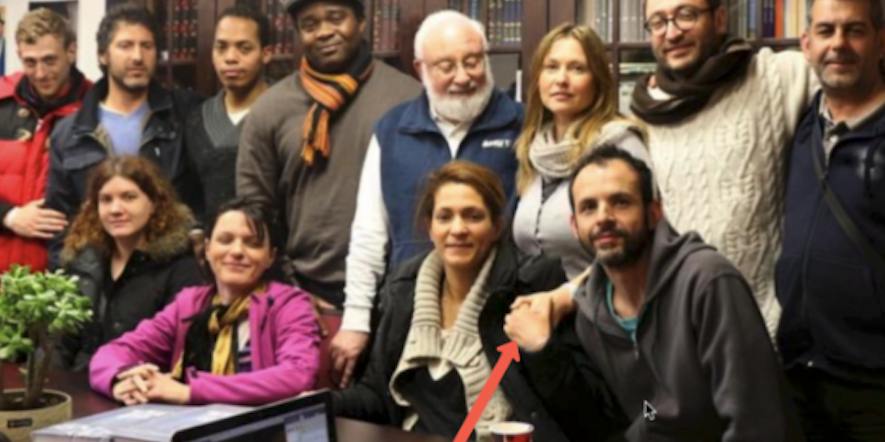
On the photo, Laitman is looking at Katya’s chest while she holds her friend’s hand in support. This is exactly what Katya described in her lawsuit—she told her friend about it, but the friend didn’t believe it was even possible.
Arye Makarevich Explains the Rules
After an evening lecture, Laitman summoned Katya to his room under the pretext of discussing Kabbalah. Fearing his intentions, she did not go. The next morning, when she offered him coffee, Laitman snapped: “I don’t need anything from you!” and demanded that another woman make his coffee.
Laitman’s bodyguard and assistant, Arye Makarevich, took her for a walk and explained: he was married but sometimes he liked other women, and this was normal. According to Katya, this was clearly meant to suggest: sex with the married Laitman is also normal. Makarevich added that Laitman had chosen her as his assistant from a photograph and preferred blondes. When Katya said that she was married, he did not reply. That evening Makarevich told her to take the gifts for the rav to his room at night. Katya knocked so quietly that he would not hear; the next morning Laitman flew back to Israel. It was not Laitman who explained the rules to her; his bodyguard did it for him, and did it in advance.

In the photo from Laitman’s circle is Arie Makarevich—his bodyguard and assistant, who rented him an expensive room with a huge bed during the congress “for spiritual rituals” 🙂
Petah Tikva. Night Calls. Fever
After the congress, Laitman began calling Katya on Skype and writing to her about her special spiritual qualities. In the summer of 2014, she arrived as a volunteer at the Bnei Baruch center in Petah Tikva. Around one in the morning, right after she landed, Laitman, Katya writes, called and summoned her to come to him at once. He told the host of the apartment who had driven her to the center that he and Katya now needed to “work.” In the apartment, Laitman touched her and tried to kiss her; Katya pushed him away. The next day he again pressed her for sex. She refused.
Following her refusal, Katya writes, Laitman alternated between rejection and sudden tenderness: “He realized I was dependent on him.” When he returned from Sochi, he called her into the study off his apartment and told her directly that he wanted to sleep with her. Katya offered a massage instead. “Do you think I have a problem with women?” he asked, adding that he hadn’t lived with his wife for twenty years. When she brought up her marriage and that an affair was unacceptable, he laughed: “We are not going to get married.” Laitman is a cynical predator: he chose his assistant from a photograph, and pressed the married student he himself had convinced that only he led to the Creator into sex.
Katya writes that by this time, the thought of Laitman’s anger and rejection had become unbearable. She viewed her body as a sacrifice to her spiritual teacher. “As a result of the psychological state I was in, I agreed to sleep with him,” the testimony states.
She describes the episode itself without euphemism: “We had intercourse. For me it was revolting. I just waited for it to be over.” Laitman convinced her not to use a condom: “Don’t worry, you won’t get pregnant.” The next day he summoned her again. According to Katya, he could not get an erection; he demanded oral sex, and upon her refusal grew enraged and threw her out of the apartment. Katya developed a high fever, her blood pressure spiked, and she lay in bed for two days. She had planned to spend two weeks at the center, but flew home after ten days. Laitman never contacted her again.
Katya articulates her own assessment of what occurred: “Looking back, I feel that he coerced me into this using psychological manipulation, and that he exploited the trust I had in him.”
Aftermath. Threats. Silence
After returning home, Katya was broken. Fear gripped the victim: she was afraid to stay alone and asked her husband not to leave the house. She had suicidal thoughts. She could no longer separate Kabbalah from the man she and her friend were already calling a “monster.”
About ten days after returning, Katya wrote to someone she trusted within Bnei Baruch, telling him that, having come to know Laitman up close, she considered him a monster. He asked if this was related to sex, and advised her to ignore the matter, continue studying, and “cross the barrier.” About a month later, after listening to a lecture by Laitman, Katya wrote to him herself, saying she seemed to have returned to Bnei Baruch, and asking what had happened and why. According to her, he replied that he was glad, that he was sorry for everything that had happened, that it was all his fault, and that he hoped they would forget everything and move on.
Katya attempted to return to classes and translations, but could no longer believe in Laitman blindly. The break began after a critical Facebook post by an author identified in the testimony as M. It showed her that Kabbalah could be studied without Laitman.
Upon leaving Bnei Baruch, Katya wrote: “I realized that I had not been working for the Creator at all, but for a greedy organization that tries to control people, and especially for Laitman, who used my spiritual aspirations to satisfy his carnal desires.”
Threats against other Bnei Baruch witnesses are examined in a separate report. Katya was prepared to confirm her testimony in court. The document’s final paragraph records that confidential information about her was leaked by people seeking to prevent her testimony; her life and the lives of her family were threatened, and in the end she declared that she would not testify against Michael Laitman.
The testimony never reached a courtroom. The court neither rejected it nor examined it, and the cult’s leader never had to answer it: the pressure worked before cross-examination. What remains is a text signed in the presence of a lawyer: Katya believed in a “channel to the Creator” and concluded that her spiritual aspirations had been exploited. Katya is not alone: Mona Andersen and Alesya testify to spiritual authority, a “spiritual” justification for sex, and pressure after the attempt to speak. Three women, three testimonies: one pattern.