0

The Milwidsky Complainant Will Not Be Questioned in the Defamation Trial

The court refused to call complainant “A” in the civil case around Milwidsky

Hanoch Milwidsky in a political context

Kira Moskaliov -

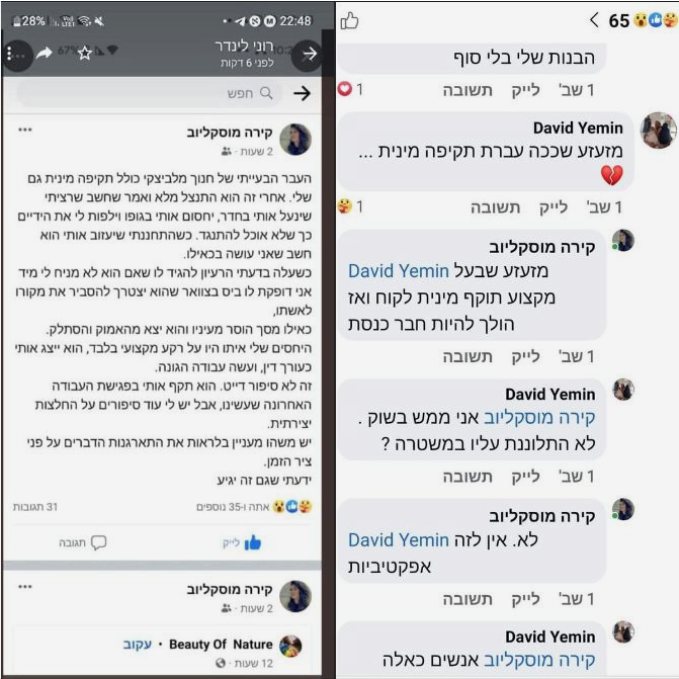
Hanoch Milwidsky's problematic past also includes a sexual assault against me. After that he apologized a lot and said he thought I wanted him to lock me in a room, block me with his body, and grab my hands so I could not resist. When I begged him to leave me alone, he thought I was pretending.

When the idea occurred to me to tell him that if he did not let me go immediately, I would bite him in the neck so he would have to explain the mark to his wife,

it was as if a screen was lifted from his eyes; he came out of the frenzy and left. My relationship with him was strictly professional: he represented me as a lawyer and did decent work.

This is not a dating story. He assaulted me at the last work meeting we had, but I have other stories of creative escape.

There is something interesting in watching how things arrange themselves along the timeline.

I knew this would come too

The Lod District Court’s decision does not remove the criminal suspicions against Hanoch Milwidsky, but it substantially limits the ability to hear, in an open civil proceeding, the woman whose testimony lies at the foundation of the key allegations. As The Seventh Eye wrote on September 2, 2025, Judge Dror Ard-Eilon refused to call complainant “A” in the defamation case that the Bnei Baruch structure is pursuing against former security employee Benyamin Rafaeli.

The testimony of “A,” taken by LAHAV 433 investigators in 2024, turned long-standing public allegations into a full criminal case. That is why the refusal to call her matters not only as a procedural episode. It shows how tightly intertwined the civil lawsuit over reputational damage, the criminal investigation into sexual violence, and the struggle over the admissible boundaries of witness testimony are in this story.

From the standpoint of public interest, this conflict is especially sensitive because the civil proceeding is not about an abstract reputation dispute. It concerns a case in which movement leader Michael Laitman and his former legal counsel Milwidsky appear in the same testimony about violence, pressure, and the later attempt to change the witness picture.

This exact gap between the case against the lawmaker and the absence of comparable movement regarding Laitman was separately described by TheMarker on August 8, 2025: “A” appears there not only as the complainant against Milwidsky, but as part of a broader group of witnesses whose accounts about Laitman did not lead to his interrogation.

Chronology of the allegations: from pressure on testimony to public retraction

According to the complainant’s own description, her story began with an allegation against Laitman, whom she linked to sexual violence during a visit to Israel. Later, when the case became dangerous for the movement, she gave court testimony that removed those allegations. Investigators and critics of the movement view that reversal as a central sign of pressure on a witness; The Seventh Eye separately emphasized that in 2022, in an interview with News 12, she repudiated the earlier testimony and again accused Laitman.

The situation changed after the 2022 television interview, in which “A” publicly rejected the previous version and again confirmed that she considered Laitman a rapist. In the same circuit, she connected Milwidsky to pressure meant to make her testify in the movement’s interests. In later publications, other people from the organization’s protective circuit also began appearing in the case, including Eli Vinokur and attorney Tzvi Galman.

In TheMarker’s July 27, 2025 publication, the same line was framed as a problem of investigative scale: the police are examining Milwidsky, but in the newspaper’s assessment, are not revealing the full picture around Kabbalah Laam and the allegations against Laitman. So the question of calling “A” in the civil proceeding concerns not only Rafaeli’s defense. It concerns where the central testimony about the connection between Laitman, Milwidsky, and pressure on testimony can be heard at all.

The civil defamation dispute cannot be viewed separately from the criminal line. Every question about the admissibility of new witnesses in it necessarily touches the broader picture: how the movement tried to neutralize allegations already voiced, and how much that strategy depended on controlling the witness testimony itself.

What exactly the complainant says about Milwidsky’s role

In the interview cited by Israeli media, “A” described Milwidsky not as a peripheral figure, but as a person who accompanied her, discussed future testimony, and, according to her, used proximity to the movement’s leadership to apply pressure. In her version, this contact did not remain limited to organizational matters.

In one of the most serious episodes, she claims that Milwidsky invited her to his office under the pretext of discussing the court case and later raped her in a hotel after the false testimony had already been given. Milwidsky himself acknowledged acquaintance and close contact with the complainant, but denied both sexual violence and participation in coercing false testimony.

Substantively, this makes her possible court appearance especially important. It concerns not only whether separate acts of violence occurred, but how sexual allegations, pressure on a witness, and the legal defense of the movement’s reputation may have joined in the same story.

Similar circumstances had already been documented in the testimonies of other women. Katya Sukhova signed her testimony under her own name, left contact details, said she was willing to speak, and did not receive a single call from the police. Mona spent sixteen years inside the structure, described pressure and violence, and none of her complaints left the external legal circuit. In the case of “A,” the mechanism is the same, but a new element was added: an attempt by the court not to admit her voice even in a civil proceeding. Different names, different years, different authorities, one function.

Why Rafaeli insisted on calling the complainant

Benyamin “Boka” Rafaeli, Laitman’s former head of security, has long been one of the most important witnesses describing the movement’s internal mechanics. After leaving Bnei Baruch, he began speaking publicly about alleged violence, pressure on witnesses, and how the organization responds to such allegations with lawsuits. On September 5, 2022, the Bnei Baruch association filed a 2.87-million-shekel defamation lawsuit against Rafaeli in the Lod District Court for his testimony in the News 12 investigation.

Rafaeli sought to call “A” in the civil proceeding because he considered her testimony central to his defense. His position, voiced by attorney Dudi Parhiya, was that he could not disclose this part of the story earlier because of investigative secrecy and fear of obstructing justice. As the attorney noted, Tzvi Galman, the association’s representative and a key suspect in the criminal case concerning pressure on the same complainant, could not be allowed to question a crime victim directly in civil court.

To overcome the expected refusal of the complainant herself to come to Israel, attorney Parhiya proposed using a lawful mechanism through the attorney general and questioning “A” in Russia by video link. For Rafaeli, calling the witness was a way to move the allegations of rape by Laitman and Milwidsky from media testimony into direct procedural evidence.

What the court refusal means in the broader context

Judge Dror Ard-Eilon refused to call the complainant, citing the procedural stage of the case: the proceeding had already passed the evidence-submission stage, and the witnesses had been questioned. The court also noted that Rafaeli had previously requested that A. be called and then withdrew that request, and ordered him to pay Bnei Baruch 4,000 shekels in costs. Formally, this decision fits the logic of a civil proceeding. In practice, it means that one of the most important testimonies in the case will remain outside the very court where Bnei Baruch is trying to defend its version of events.

That collision makes the case revealing. On one side, the criminal investigation is built around claims of pressure, false testimony, and sexual violence. On the other, the civil proceeding in which those claims could have been heard directly is constrained by procedural boundaries favorable to the side that already has the stronger organizational and legal machine.

Against this background, the court refusal becomes part of the broader picture described by TheMarker: procedural activity appears around Milwidsky, Galman, and Vinokur, but the Laitman line remains without a comparable interrogation. The civil court formally decided the question of the procedural stage, but in effect another official circuit did not hear a witness whose words matter to both lines at once.

The political background only amplifies the significance of the decision. Despite the gravity of the allegations and the expansion of the circle of people questioned, Milwidsky received the important position of chair of the Knesset Finance Committee. As a result, the question of who and where will be able to speak on the record about his role remains not only a legal problem, but an institutional one.

This court decision is not the only moment when the system closed a channel. In Katya’s case, the police closed. In Mona’s case, the internal complaint-response mechanism closed. In “A”'s case, the court closed. Each time the tool is different. The result is the same: a voice capable of forming the evidentiary picture remains outside the official circuit. It is precisely this repetition that turns separate procedural decisions into a description of a system.

Complainant “A” is the same woman who described violence by Laitman, was brought to Israel, gave false testimony, and then, according to her, was raped by Milwidsky in a hotel. She was not called in the civil proceeding.

The public influence circuit around Milwidsky

Continue reading: The closed kindergarten case - how a complaint about abuse in a Bnei Baruch institution was stopped at the stage of police review.

Sources

Share your story anonymously

Write to us at: LAITMAN.HUI@MAIL.RU

Article navigation

Continue reading