A letter in Laitman’s name: how the cult buried the complaint of sexual abuse in the kindergarten
Where you are in the dossier: Harm and testimonies Mixed evidence
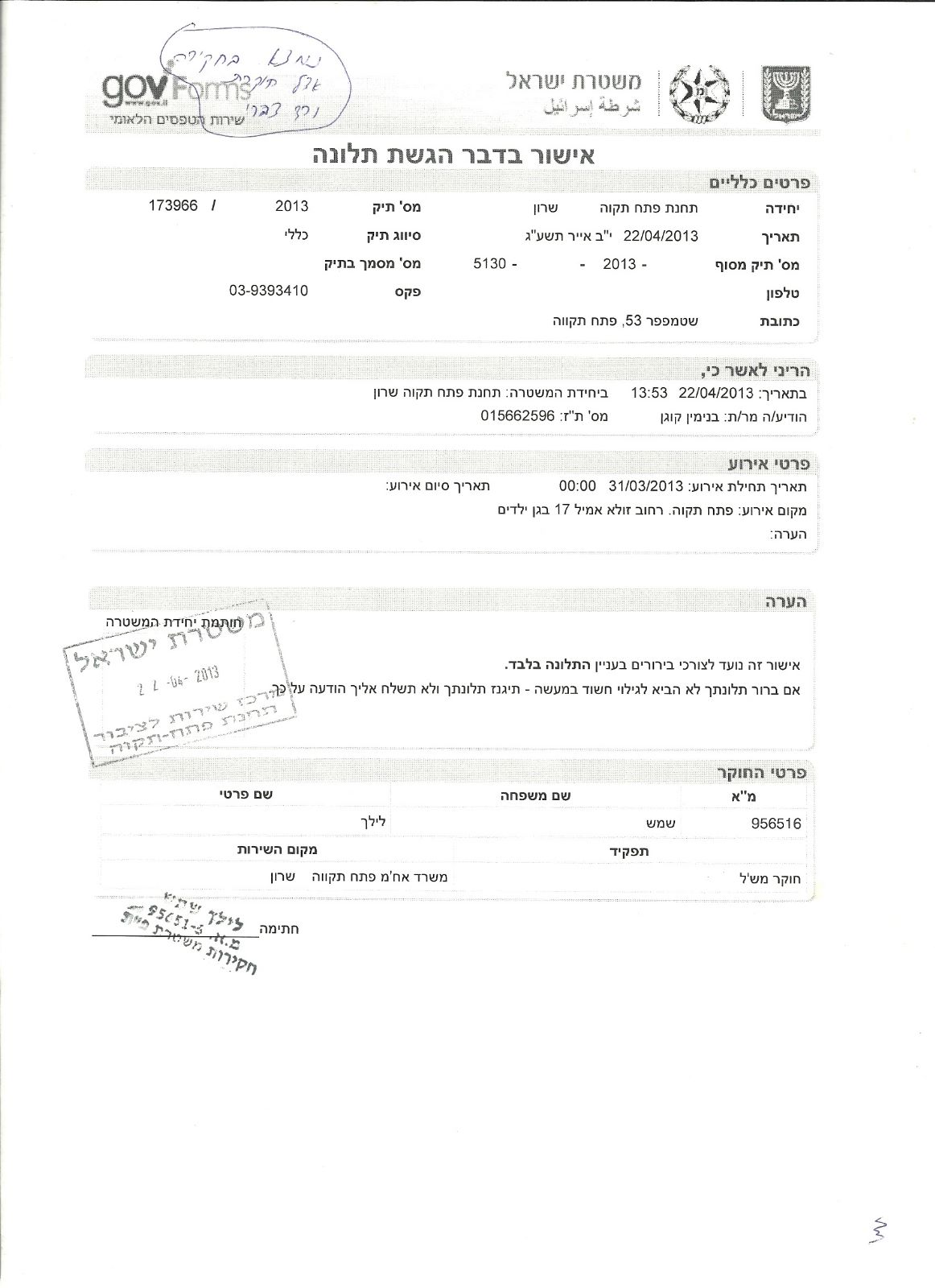
This image is related to a closed police case involving a kindergarten of Laitman’s organization, where a complaint of sexual abuse of children was dismissed at an early stage, and a key role in neutralizing the complaint points to police officer Ami Liberman, who is a student of Laitman.
The Global Garden story begins with a letter. On 31 March 2013 a text went out to parents in Michael Laitman’s name: children left unsupervised, rough treatment, threats, isolation, unsafe conditions, and possible sexual abuse between children in the kindergarten.
All of it survives in preserved correspondence with names: the softening happened at once and in the open, in the same mailing list, in front of the parents. The letter was written at the request of Michael Laitman’s daughters, Yael and Rachel. Four days later those same authors revised the three gravest allegations, and on 22 April Binyamin Kogan took the matter to the Petah Tikva police. The Laitman family set the frame.
What parents described inside the “Global Garden”
The first letter to parents contained a separate section on episodes tied to possible sexual abuse between children. The newsroom knows what that meant: one child led others into the toilet, locked the door and penetrated them with his fingers. There was more than one victim.
The authors named themselves. On 4 April Yael and Rachel Laitman, Michael Laitman’s daughters, wrote to the same list: they had asked the Rav to write the letter in his name, and they needed the urgency and the shock. On 31 March itself, Oren Leibovich told parents he did not confirm what was written: all of it had been told to him and to Shira by women of the Laitman family. The newsroom knows something the correspondence does not show: Yael Laitman removed her son from the kindergarten, and people saw it.

An image used in the project's materials on the younger circle of the Bnei Baruch cult.
The correspondence shows that parents were afraid for their children, and for their place in the group. The threat of expulsion from the “spiritual family” and isolation turned a simple parental question, “what happened to my child?”, into a test of loyalty.
How the crisis was translated into the language of a “spiritual test”
The letters and replies lean on the language of spiritual work: “the right intention,” “rise above the situation,” “do not destroy unity.” Where concrete facts demanded checking, that language pushed toward faith and submission: fear, harm, humiliation, and possible sexual abuse were named a “test,” and responsibility dissolved. Nobody asked who allowed the risk; the question became whether parents were reacting spiritually enough.
On 1 April, a day after the letter about possible sexual abuse between children went out, Laitman writes four lines to the list: “I think I did what I had to do,” “there is no more need for me,” “I do not belong to the future of the kindergarten,” “I also ask that you stop calling it ‘Global’.” About authorship he says nothing, neither confirming nor denying. Three days later his daughters would write that the Rav knew their opinion that his grandson’s kindergarten was not being run properly, but he was not aware of the details. Laitman’s hypocrisy here is not judgment but arithmetic: they ask him to write a letter in his name listing specific failings, yet he himself, by their account, knew none of them.
That same 4 April, the same authors revise the three gravest points of the original letter, each in its own way. They withdraw the classification “maase sdom” outright: a single incident between two small children, which, according to the kindergarten management, had been reported to parents, after which a psychologist was brought in. The shaking case, according to the management’s own account, was handled and reported. The description of staff violence is changed by the very mother who reported it: not a slap, but wild behaviour and shouting. Binyamin Kogan replied that same day: suspicions of possible criminal acts had been presented as personal testimony, supposedly based on footage too, and were not checked before the mailing went out. It was not “a single incident”: there was more than one victim, as the newsroom knows. Inside the cult it was explained differently: children that age do not understand what they are doing, it is a game. That is a lie: what the adults in the kindergarten called a game was what one pupil was doing to several children. The accusation of 31 March and its revision of 4 April sit in the same file, published here in full. The Bnei Baruch directorate letter covers this separately.
How the complaint reached the police and what is known of its fate
On 22 April 2013 Binyamin Kogan filed a complaint with the Petah Tikva police. The record shows the complainant, the date, and the location: a kindergarten at 17 Amal Street. This is the one step in the whole affair that no longer depended on the cult’s internal correspondence. Three materials of different origin confirm different things: parent correspondence from March and April 2013 records the accusations and the replies to them, police confirmation of 22 April records the filing of the complaint, and in the Ynet report of 4 March 2016 Kogan, three years later, speaks himself of his own removal. None of them records what happened to the complaint afterward. The same pattern repeats at every step: first an alarming report, then softening, then silence.
The newsroom has learned from Ami Liberman himself: he helped close the case because he had connections inside the police. Liberman is a student of Laitman and a police officer: the link between the cult and the police runs through one man. This is his own admission. The newsroom has also learned from Michael Laitman himself that Ami Liberman helped close this case. Liberman and the head of the cult name the same thing. Laitman knew the case was closed, and knew who helped close it.
The closure is attested by Liberman and by Laitman themselves. This is a cover-up: a student of Laitman’s who served in the police helped close a complaint of sexual abuse between children in the cult’s kindergarten. The cult protected itself, not the children.
The newsroom knows that after the police complaint the Kogan family was pushed out of the cult, put on an internal blacklist, moved into isolation, and the sanctions reached the child. Binyamin Kogan went to an investigator, and the whole family paid. The removal he later describes in his affidavit and the removal after the complaint are the same event. The published record says otherwise: according to the Ynet report of 4 March 2016, Kogan himself names a personal crisis and psychological pressure inside Bnei Baruch as the cause of his removal, and social sanctions, he says, were imposed on him more than once by various committees. The published version and the one known to the newsroom diverge on the cause. Kogan himself describes the instrument: committees applied sanctions to those considered insufficiently obedient. How that instrument strikes someone who went to the police is recorded in the same Ynet report, in an affidavit filed in court by another woman, whom the outlet calls “Anna” (name changed; not Binyamin Kogan’s wife). In 2013 her husband beat her, and her best friend in Bnei Baruch told her “under no circumstances” to go to the police. When the police detained her husband, a fellow member told her “never to come to the center again,” and “Anna” understood that she had “damaged Bnei Baruch’s reputation by involving the police in an ‘internal’ matter.” Later she was told “that if I withdrew the complaint from the police, I could return to the group.” In Anna’s affidavit, return to the cult is traded for withdrawing the complaint from the police.
What this episode shows about the cult as a whole
The cult had chosen image over children before. On 22 August 2012, seven months before the letter in Laitman’s name, Haaretz published a letter from the spiritual directorate about roughly six women: some of them woke small children every night to watch the morning lessons. “It is clear beyond doubt that this is behavior… harmful both to the children and to the image of the society,” the directorate wrote, and decided not to allow “these women and their children… without a single exception.” The children the directorate itself said were being harmed were expelled together with their mothers. Bnei Baruch’s reply to the newspaper said something else: “the information we had was only in the nature of rumor,” and therefore “we did not see it as our role to turn to the welfare authorities.” For its own, beyond doubt; for the newspaper, mere rumor. In April of that same year the directorate, after an affair over unreturned loans, removed one of the participants “and his family from all activity in ‘Bnei Baruch’” and added: “The above includes all the groups of Israel and the world.” Harm to children and harm to image sit in one sentence, no outside authority is called, and a whole family is suspended for one person’s act: that is how the cult already worked in 2012.