Signs of a Destructive Cult: Where the Documented Record Matches the Experts' Criteria
Where you are in the dossier: Control mechanics Synthesis
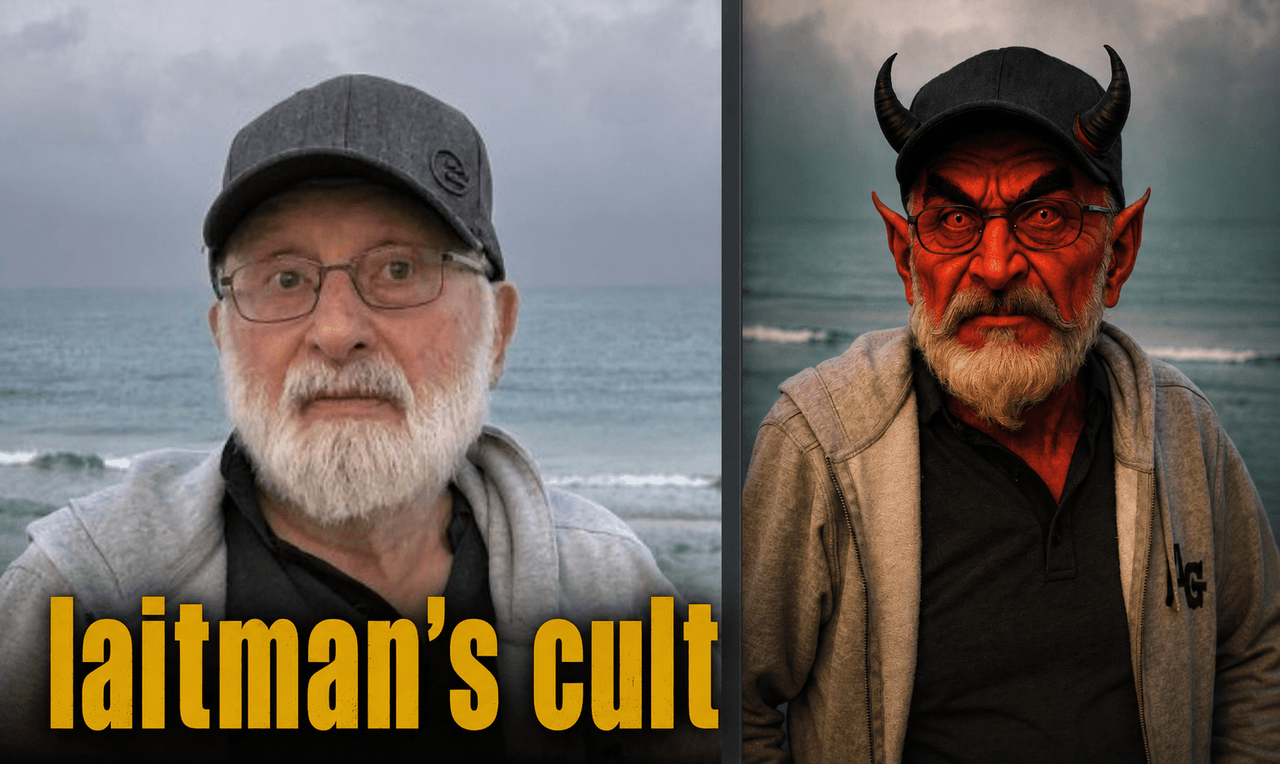
A collage from critics of the cult: Laitman's public image and its "dark" version. An illustration of this page's question: where the documented practice diverges from the storefront.
Below are eleven markers by which researchers of destructive cults and support centers identify a cult. Next to each: what Laitman’s structure has documented about itself: internal regulations, court records, state regulator’s audit, media reports, and testimonies.
The Israeli Center for Cult Victims officially documented that Bnei Baruch has “signs of a cult both in the professional sense (as defined by researchers and therapy specialists) and in the public sense” (Kikar, 2023). Director Rachel Lichtenstein confirmed this in a court affidavit in the very proceeding the association itself had brought against a critic (The Seventh Eye, 2017). International mind-control researchers employ similar marker sets, from Robert Jay Lifton to Steven Hassan; the signs checked here are common to most methodologies.
Eleven Markers
1. Control of Time and Sleep
The internal regulations set the morning lesson from 3:15 to 6:00 as a daily obligation, prescribe no less than 5.5 hours of sleep, and require going to bed no later than 21:30. What this regimen does to work, family, and the body over the years is in the article on the path inward; the rules themselves are in the cult’s regulations.
2. Sealing the Information Loop
A participant is forbidden to take up another “spiritual” direction, to read materials not approved within the cult, or to “listen to another rabbi”; only edited and censored media reaches the outside, and only designated people may speak on the cult’s behalf. The breakdown is in stage 7 of the path inward.
The same loop closes around the death of a participant. On January 18, 2021, the public broadcaster aired an investigation by Gur Megiddo. At timestamp 16:02, the journalist himself draws the line: “In recent times there have been several cases of suicide among people in Bnei Baruch… We, of course, do not accuse the cult in the suicidal act itself, but we wanted you to see how it dealt with the case.” What follows is only about the response. Patrick, town of Bolton, county of Ontario, Canada: at age 29, he joined the Bnei Baruch enterprise in Toronto. A year after joining, he was found dead; he left several suicide notes.
A colleague who worked with him for a year in the North American cult told the investigation that at the weekly conference call, everyone was told: Patrick had “simply left.” That he had killed himself, she learned by accident, days later. By her account, this is how things are handled here: “They treat it like it doesn’t exist. We don’t talk about it, everything’s fine, everything’s good, we’re on the right path, everything’s perfect.” From the moment she told everyone the truth, her expulsion became a matter of time.
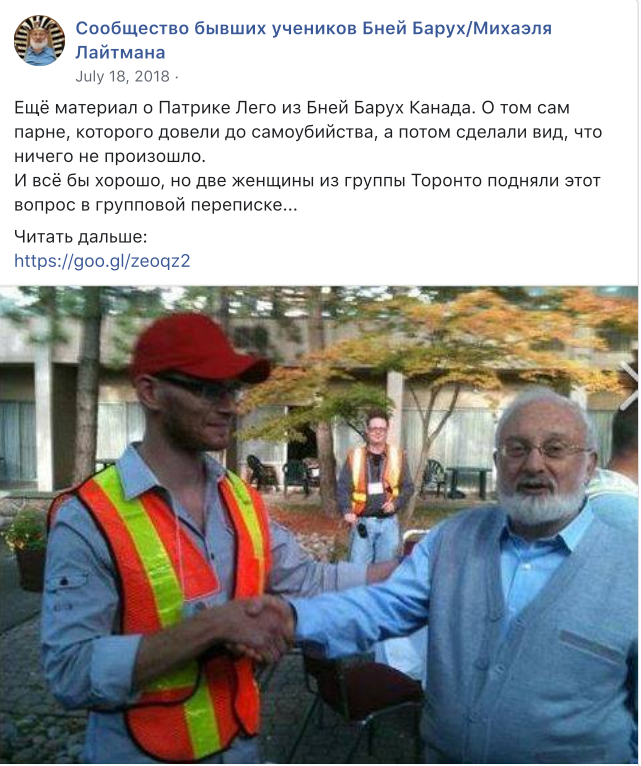
A post by former students dated July 18, 2018; in the frame, Patrick is shaking hands with Michael Laitman.
The editors know what stood behind his death: Patrick wanted to marry Laitman's younger daughter, Rachel, was refused, and after that refusal he died by suicide. Inside the cult this context was known, and no meaningful help came to a man in crisis. The man died, and inside the cult his death was turned into a convenient formula: he had "simply left."
Another case: Petah Tikva. According to testimonies received, the deceased’s friends were asked not to attend the funeral, yet asked to attend Rabbi Laitman’s lesson. The lesson is Laitman’s lesson: the cult has no other center of decision. Three actions in sequence: death announced as departure; the person naming it aloud squeezed out; the funeral replaced by a lesson. None concerns the cause of death. All three concern how the cult managed the fact.
3. Economic Binding
A monthly tithe (maaser) and mandatory payments are fixed in the regulations as a condition of membership. An internal document on the communal meals shows a hidden surplus of 422,826 shekels behind the language of “care,” and the Registrar of Nonprofits’ audit records reporting violations. The money is examined in the financial framework and the document on the seudot.
4. Control of Marriage and Partnerships
The regulations require members to “be married” and quote Laitman: an unmarried man “cannot advance.” According to Rafaeli’s counter-letter, attached to the lawsuit against him, participants were given instructions on choosing partners and on separating from them; Libi, according to TheMarker’s reporting, was pushed toward a quick marriage inside the cult. See the path inward, silencing testimonies, and the legal breakdown.
5. Sacralizing the Leader and Blocking Doubt
“Now he speaks to me through the teacher”: a formula from a congress video recording. An inconvenient question is shut down with the answer “faith above reason.” A student who wrote about the lie in the system is told in reply that he sees it all “in his own distorted egoism.” See “The Creator Speaks Through the Teacher” and the “How Do I Go On Living?” correspondence.
6. Mutual Surveillance and Guarantorship
The regulations require reporting a fellow member’s violation to the society’s committee; silence is declared complicity. At the congress, appointed “police” operate, and the guarantor of a rule-breaker leaves the grounds together with him. See the Arava congress takanon and the path inward.
7. Punishing Those Who Leave and Those Who Report
After Mona left publicly, the cult, according to her testimony, posted her personal details and accused her of prostitution. The Kogan family, after going to the police, says it was placed on “blacklists” with a ban on contact. Katya, after preparing a publication, received threats against her family. See Mona’s testimony, the closed AMI case, and Katya’s testimony.
8. Suppressing Criticism Through Lawsuits
Four lawsuits against a single journalist were lost or withdrawn; the courts recorded in writing the markers of SLAPP, forum shopping, and abuse of process; two Kan investigations were taken down under a confidential settlement. See the cult’s legal machine.
For thirteen years, the legal machine has worked as a single mechanism: speak aloud, get sued. Defendants have been journalists, an investigative news site’s editorial staff, army radio, public broadcasting, a support center for victims, Laitman’s former security chief, and a man who wrote about the cult to the ministry.
Lost cases never stopped the mechanism: after each dismissal the next suit was filed, sums climbing from 600 thousand to nearly three million shekels. The plaintiff is the amuta, not Laitman personally, yet it has a single leader, and the judicial pressure holds exactly as long as he directs it. The price exacted from those it silenced is counted nowhere. The full year-by-year chronology of the suits is in the timeline, the mechanism and the courts’ own wording in the cult’s legal machine.
9. Keeping Complaints Inside
The human-resources director responsible for preventing harassment testified under oath: “I did nothing.” The complaint of complainant “G” at the police “got lost” until the newsroom asked about it. Affidavits vanished after meetings with people from the cult. See silencing testimonies and the Shadmon family circle.
10. Double Standards at the Top
Discipline, dues, and the nighttime regimen are for the rank and file. At the top, the documented record includes helicopter transport for the director general, exemptions from the distancing rules for close associates, and flexibility on religious norms whenever they get in the apparatus’s way. See Mushi’s privileges, the hierarchy of access, and the religious storefront.
11. Sexual Access Under the Guise of Spiritual Status
The gravest of the documented markers concerns sex and is not limited to the leader. The summary of the five complainants’ testimonies describes “a system of intimate relationships with Laitman and other senior members, using their spiritual authority”; Katya reports an assistant’s words that the married leader “had the right” to such a choice, Mona that closeness with men from the inner circle was demanded “through their special spiritual status.” Rachel Lichtenstein, director of the Israeli Center for Cult Victims, testified that the harm “trickles down to other men in the cult”; according to Ilanit Yezersky’s testimony, Laitman admitted the relationships, saying he had “harmed no one.” The same logic from his own mouth on video is in the doctrine on women; the procedural level is suspicion in the LAHAV 433 investigation into Hanoch Milwidsky.
How This Maps onto the BITE Model
The same eleven markers fall into the four categories of control that psychologist Steven Hassan described as the BITE model: control of Behavior, Information, Thought, and Emotion.
| # | Marker | BITE category |
|---|---|---|
| 1 | Control of Time and Sleep | Behavior (B) |
| 2 | Sealing the Information Loop | Information (I) |
| 3 | Economic Binding | Behavior (B) |
| 4 | Control of Marriage and Partnerships | Behavior (B) |
| 5 | Sacralizing the Leader and Blocking Doubt | Thought (T) |
| 6 | Mutual Surveillance and Guarantorship | Information (I) / Behavior (B) |
| 7 | Punishing Those Who Leave and Those Who Report | Emotional (E) |
| 8 | Suppressing Criticism Through Lawsuits | Information (I) |
| 9 | Keeping Complaints Inside | Information (I) |
| 10 | Double Standards at the Top | Behavior (B) |
| 11 | Sexual Access Under the Guise of Spiritual Status | Emotional (E) / Behavior (B) |
The eleven markers converge on one conclusion. Bnei Baruch is not a “school of Kabbalah”; it is a destructive cult that has documented its own control: sleep, money, marriage, information, fear. All eleven markers have concrete grounding in documents, internal regulations, testimonies and recorded episodes of this corpus, and all eleven are held by one hand, the hand of Michael Laitman.