Natalia Oborina and the internal hierarchy of access around Laitman
Natalia Oborina and the internal hierarchy of access: how exceptions to the rules work around Laitman
This article is not about the private lives of individual participants as such, but about the mechanics of privileged access inside the Bnei Baruch structure. Open posts, event photographs, and descriptions from former participants point to a long-standing pattern inside the organization: some people are allowed behavior that would be impossible for ordinary followers, while the consequences of those episodes fall unevenly on the people involved. A particularly revealing figure in this system is Anatoly Belitsky (“Tolik”), while the most visible example of exceptional access is Natalia Oborina.
For an investigative reading, the key issue is not simply that romantic or sexual relationships may exist in a closed environment, but how the system responds to them and whom it protects. If a woman is pushed to the margins or removed from the structure after an internal scandal, while a man linked to the same episode retains his status, mobility, and access to leadership, the issue is no longer private morality. It becomes a question of power distribution. Read together with reporting on the hidden financial architecture and other testimony about blurred boundaries around Laitman, this story makes it possible to view the behavior of specific people as part of a wider system of control and inequality.

The publicly available images cited in this article show a recurring pattern of Belitsky's proximity to different women within the structure.
Anatoly Belitsky and the logic of internal immunity
According to the descriptions of this internal environment, Anatoly Belitsky does not appear to be merely a man with informal personal influence. He looks like a figure who is permitted more than most other participants, and that asymmetry is precisely what makes him important for understanding the organization as a whole. If the accumulated testimony is correct, Belitsky’s relationships with women inside the community were not treated as a risk to his standing. On the contrary, the structural consequences of such episodes appear to have fallen primarily on the women, while he remained secure inside the system.
For a closed organization, that is an important signal. In any environment that publicly declares strict discipline, spiritual purity, and submission to collective rules, the same type of breach should produce at least a broadly comparable response. When one participant remains effectively untouchable for years, the question is no longer only about his personal conduct, but about the function he serves for those above him in the hierarchy. This kind of immunity rarely exists on its own. It usually implies protection from above and the silent consent of the apparatus.
At that point, the story ceases to be about a mere womanizer inside the community. It begins to look like the story of a man entrusted by the system with a specific role in relation to the organization’s female circle and therefore shielded from normal consequences. From a journalistic standpoint, that is the central sign of something institutional rather than accidental.
Public congresses as demonstrations of permitted behavior
It is especially revealing that this pattern, according to the project’s account, was not fully hidden in the shadows. At major international Bnei Baruch congresses, Belitsky is said not to have acted as though he needed invisibility, and could appear openly with different partners. In a setting built around the language of spiritual discipline, a single norm, and hierarchical submission, that kind of public visibility carries a particular meaning. It signals not weak control, but the opposite: confidence that no punishment will follow.
For thousands of ordinary participants, that visual contrast functions as an unspoken lesson. They are shown that different categories of people exist inside the system, and that different regimes of permission apply to them. Some are expected to obey formal and informal prohibitions, while others may violate those limits without obvious damage to their status. In closed structures, such scenes help produce a discipline of silence: people do not merely witness exceptions, they understand that challenging them is dangerous and likely futile.
That is why the significance of these episodes does not lie in gossip as such. They matter as markers of vertical power. If demonstrative behavior meets no visible resistance from the administration, it is likely built into the structure of what is permitted and serves a function understood by the internal leadership.
Natalia Oborina and the figure of exceptional access
One of the clearest examples of that internal logic of access in this article is Natalia Oborina. At the official level, Michael Laitman is presented as a religious and spiritual leader surrounded by strict rules of distance, especially with regard to women. Yet publicly available images and descriptions from events suggest that a different regime applied to Oborina. She could accompany Laitman, remain close to him, and approach him in ways that were unavailable to most other female participants.
By itself, a photograph does not prove the entire mechanism. But in a closed organization where bodily distance and access to the leader are part of symbolic power, such exceptions cannot be treated as neutral. They point to the existence of an internal caste of trusted women for whom the rules are redistributed. And once such exceptions become visible before thousands of people, they begin to function as a form of public ranking: some remain on the periphery, while others acquire the right to physical and status proximity to the center of power.
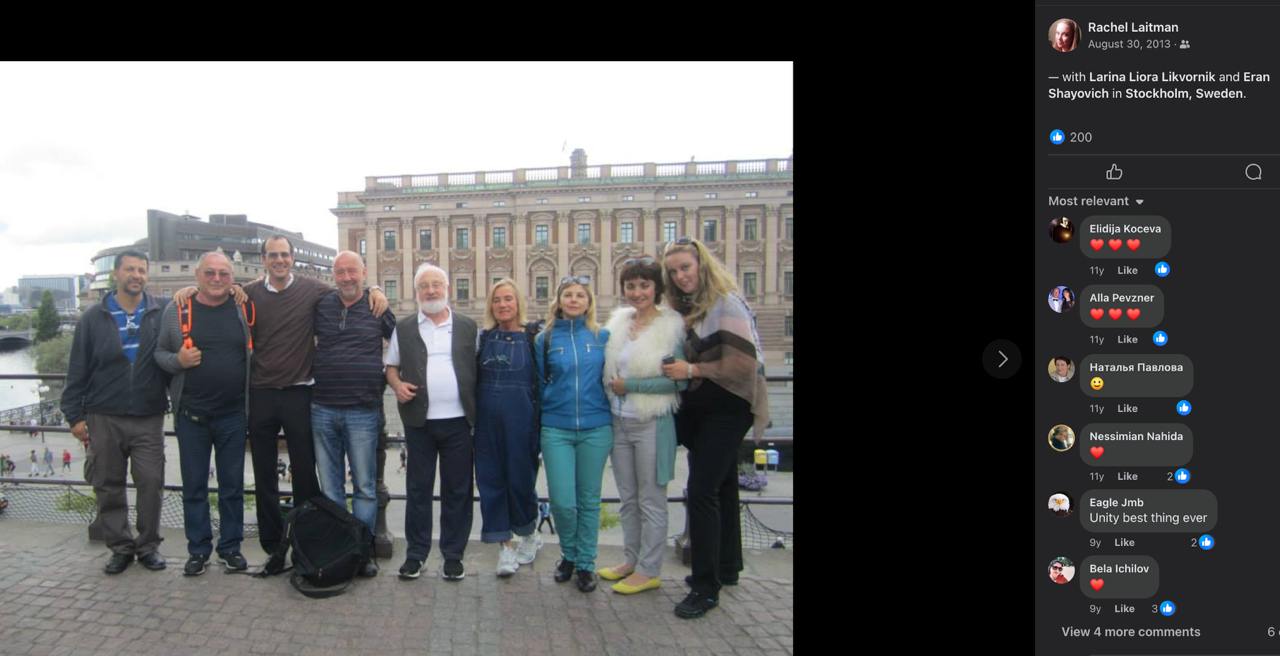
In the project's reading, Oborina's image is treated not as a random instance of proximity, but as a sign of privileged standing within a closed circle.
In that context, Oborina’s name matters not only as the name of one particular woman. It signifies the model of selection and admission itself, in which closeness to the leader is not distributed formally, but granted through unofficial channels. For any investigation, that is crucial because it allows one to speak about a structure of personal service and privilege precisely where spiritual equality and religious discipline are officially proclaimed.
The contrast between official discipline and actual practice
What is most damaging to the organization’s public image is precisely this gap between the norm it preaches and the practice it appears to permit. For outside audiences, Bnei Baruch may speak in the language of spiritual work, modesty, control over egoism, and respect for religious boundaries. But when that rhetoric coexists with internally protected men and women enjoying a special regime of access to the leader, the rhetoric itself starts to work against the organization.
In such systems, moral demands are almost always directed downward. They are imposed on ordinary participants, from whom obedience, sacrifice, and control over private life are expected. At the same time, an upper zone of exceptions emerges in which the real logic is determined not by proclaimed principles, but by the usefulness of particular people to the leader and his circle. That is why the story of Belitsky and Oborina matters not as a lurid anecdote, but as an episode in which the mechanism of double standards becomes unusually visible.
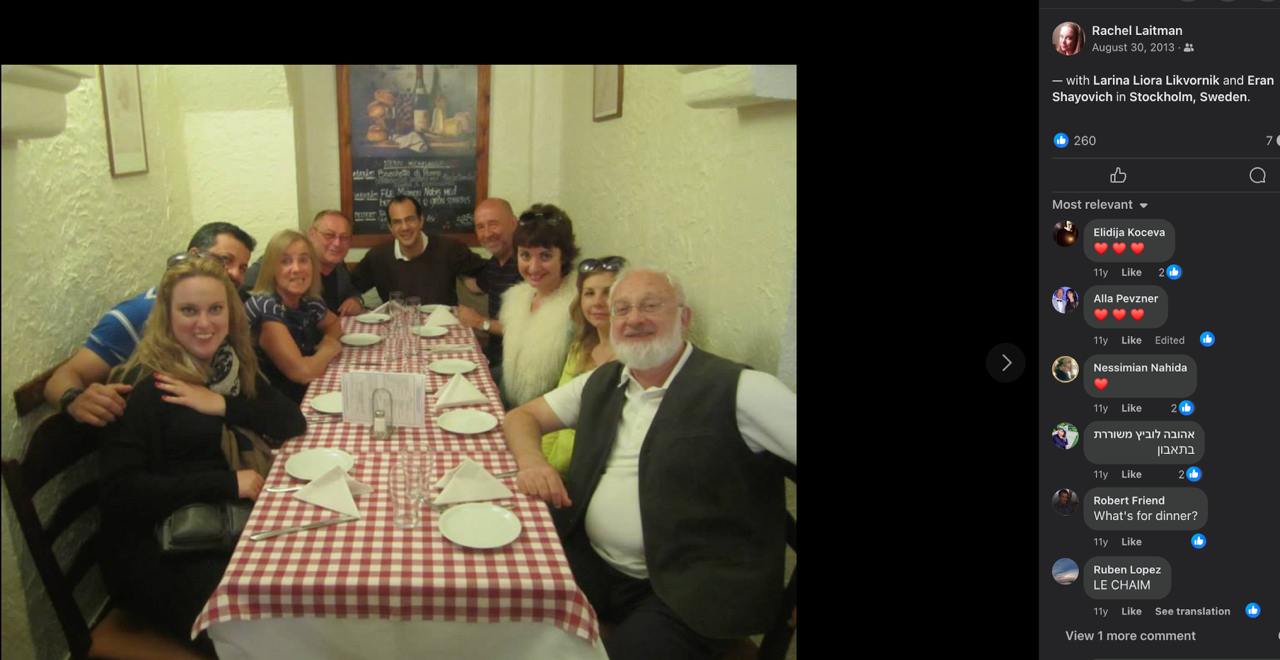
Publicly visible proximity to the leader in a system that formally restricts such access inevitably raises questions about an unofficial hierarchy of privilege.
This contradiction gives rise to the central journalistic question: are these isolated coincidences, or part of a reproducible system of selection, protection, and reward? The more such exceptions are documented across different contexts, the weaker the argument for chance becomes and the stronger the inference that what is being observed is structural.
The family and managerial cover structure
This story does not exist in a vacuum. Internal privileges linked to access to the leader are rarely sustained by one person alone; they are usually supported by an entire management circle that controls resources, day-to-day logistics, and reputational protection. In the case of Bnei Baruch, that matters especially in light of reporting on the family’s financial architecture and materials on the privileged lifestyle of the managerial circle. If the family and its closest managers in practice run the organization as a closed circuit, then exceptional access to the leader should be understood not as an autonomous personal quirk, but as part of the same model.
That is why the central issue in the story of Belitsky and Oborina is not only the private morality of particular participants, but the collective responsibility of the leadership. Who authorizes such a system? Who decides which rules are mandatory for the majority and which may be suspended for the chosen few? And why does a structure that publicly demands discipline and self-restraint internally allow an order in which bodily and status proximity to the leader is distributed through unofficial channels?
Those are the questions that connect this article to the wider picture. It suggests that the problem does not lie in one scandalous episode, but in the organization of an environment where personal loyalty and usefulness to the upper layer matter more than the norms being publicly proclaimed. As long as that asymmetry remains, any statements about spiritual ethics will continue to collide with the fact that the public images, internal relationships, and regimes of access reveal more about the structure than the organization’s official texts do.
Sources
This article is based on publicly available profiles, photographs, and visual materials referenced in the text: open posts connected to Anatoly Belitsky and Natalia Oborina, as well as event images from the organization embedded in the article.
Share your story anonymously
Write to us at: LAITMAN.HUI@MAIL.RU