"How Should I Go On Living?": A Disciple's Letter About Lies in Bnei Baruch and Michael Laitman's Reply
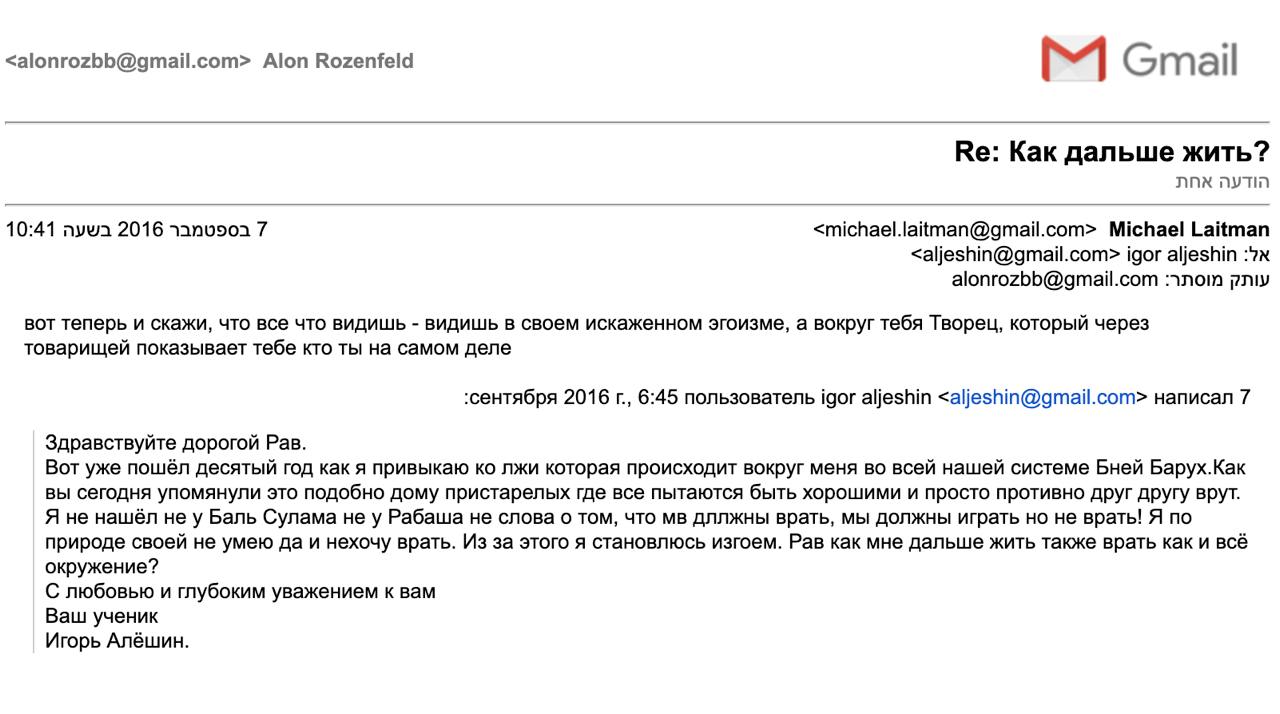
“How Should I Go On Living?”: A Disciple’s Letter About Lies in Bnei Baruch and Michael Laitman’s Reply
Original email:
Re: Как дальше жить?
הודעה אחת
10:41 שעה 2016 בספטמבר 7
<michael.laitman@gmail.com > Michael Laitman <aljeshin@gmail.com > igor aljeshin: אל alonrozbb@gmail.com : עותק מוסתר
вот теперь и скажи, что все что видишь - видишь в своем искаженном эгоизме, а вокруг тебя Творец, который через товарищей показывает тебе кто ты на самом деле
7 сентября 2016 г., 6:45 пользователь igor aljeshin <aljeshin@gmail.com > написал:
Здравствуйте дорогой Рав. Вот уже пошёл десятый год как я привыкаю ко лжи которая происходит вокруг меня во всей нашей системе Бней Барух.Как вы сегодня упомянули это подобно дому пристарелых где все пытаются быть хорошими и просто противно друг другу врут. Я не нашёл не у Баль Сулама не у Рабаша не слова о том, что мы должны врать, мы должны играть но не врать! Я по природе своей не умею да и не хочу врать. Из за этого я становлюсь изгоем. Рав как мне дальше жить также врать как и всё окружение? С любовью и глубоким уважением к вам Ваш ученик Игорь Алёшин.
English translation:
Re: How should I go on living?
One message
September 7, 2016, 10:41
Michael Laitman <michael.laitman@gmail.com> To: igor aljeshin <aljeshin@gmail.com> Bcc: alonrozbb@gmail.com
Now say that everything you see, you see in your own distorted egoism, while around you is the Creator, who through the friends shows you who you really are.
On September 7, 2016, at 6:45, igor aljeshin <aljeshin@gmail.com> wrote:
Hello, dear Rav.
It is now almost the tenth year that I have been getting used to the lies happening around me throughout our entire Bnei Baruch system. As you mentioned today, it is like a nursing home where everyone tries to be good and simply lies disgustingly to one another.
I did not find, neither in Baal HaSulam nor in Rabash, a single word saying that we must lie. We must play, but not lie! By nature I do not know how to lie, and I do not want to. Because of this I am becoming an outcast. Rav, how should I go on living: should I lie the same way as the whole environment?
With love and deep respect for you, your student, Igor Aleshin.
The editors have thousands upon thousands of internal Bnei Baruch emails. Against that backdrop, this one does not disappear. On the contrary, it helps reveal the common handwriting.
Personal messages to Laitman, again and again in this correspondence, stop being personal. They are copied to his people, the ones who keep a protective layer around him, filter problems, and are brought into the matter immediately. That is what happens here too. A man writes directly to Laitman. But even before we get to the reply, it is obvious that the letter no longer belongs to just two people.
The document itself is short. That makes its meaning sharper. This is not a journalist, not an outsider, and not some random embittered person. This is a disciple who spent almost ten years inside the system, writes respectfully, and asks not for someone to be punished but for an explanation of how to live amid lies. In return he gets not a conversation on the merits, but a neat return of blame to himself.
Not an outsider, but one of their own
On September 7, 2016, at 6:45 a.m., Igor Aleshin writes directly to Michael Laitman. The letter opens calmly: “Hello, dear Rav.” There is no challenge in it, no abuse, no blackmail. It is the voice of someone who has been inside for a long time and still speaks to the leader as to a final authority.
The central sentence is simple and heavy: “It is now almost the tenth year that I have been getting used to the lies happening around me throughout our entire Bnei Baruch system.” This is not an argument about the movement’s public image and not an attack from outside. It is someone from within saying that lies have become part of ordinary life.
Aleshin does not demand that anyone be punished. He does not threaten to leave. He asks how he is supposed to go on living if the people around him lie and he neither wants nor knows how to lie. He adds that he found no justification for this in Baal HaSulam or Rabash. For a believing disciple, that is the heart of the matter: he sees a gap between what is preached from above and what is practiced below.
Four lines instead of an answer
Laitman replies the same day, at 10:41. Four lines. Not a single question about what is actually happening inside the system. No request for clarification. No sign that the substance of the complaint interests him at all.
Instead of an answer on the merits, Aleshin receives another operation: “Now say that everything you see, you see in your own distorted egoism, while around you is the Creator, who through the friends shows you who you really are.”
It matters to read this slowly. Laitman is not arguing with the disciple. He is doing something more useful for himself. He removes the subject of the conversation. If you see lies, then the issue is not the lies. The issue is your vision, your inner instrument, your egoism. After a formula like that, there is nothing left to verify. No need to ask who lies, why they lie, or why the man has become an outcast.
Not an answer, but a return of blame
The meanness of this letter is not in its harshness. It is not harsh at all on the surface. The meanness lies elsewhere: a man who asks for help and calls lies by their name is handed blame instead of an answer.
Aleshin writes about what is happening around him. Laitman quickly moves the conversation inside Aleshin himself. The source of the problem is no longer the environment, the people, or the constant lying, but his own “distorted” perception. That is manipulation in its pure form. It looks like spiritual advice, but it works as the system’s defense.
This move is extremely convenient. After it, there is no need to discuss facts. No need to check anything. No need even to pretend that the complaint was heard. It is enough to make the person doubt himself. In that moment, power stays above and the weight falls downward again.
Why the Bcc matters
One more detail makes the episode even harder to read: the blind copy to alonrozbb@gmail.com. Formally, this is a personal appeal from a disciple to a teacher. In practice, another person is already sitting in the channel: Alon Rozenfeld.
This is where a pattern visible in the much larger body of correspondence available to the editors becomes especially clear. Laitman does not simply receive personal letters. Such letters are copied to his workers, to the people who protect him, hold the situation, and are brought into it immediately. What looks like a private appeal for help is in fact moving through a protective layer around the leader.
That changes the reply as well. It stops looking like spontaneous sincerity and starts reading like part of a managed scheme. The complaint arrives. The necessary people are copied in. The man at the top does not need to enter into the pain or verify facts. A short formula is enough, one that sends blame back to the sender and keeps the system out of harm’s way.
How should I go on living?
Aleshin’s question, “How should I go on living?”, remains unanswered. What he gets instead is a suggestion not to trust his own perception.
That is exactly why this letter matters. In it, you can see how Laitman steps away from the substance, how he shifts the conversation from lies inside the movement to the disciple’s “egoism,” and how even a personal letter immediately enters a service circle around him. Here his falsehood reads not like sincere error, but like convenient manipulation.
After documents like this, Laitman’s words about truth, care, spiritual honesty, and “the friends” cannot be taken on trust. They have to be checked against documents, correspondence, and the way the system behaves toward living people. This letter is one of those documents.
Share your story anonymously
Write to us at: LAITMAN.HUI@MAIL.RU